In Exercises 69–76, graph each function not by plotting points, but by starting with the graph of one of the standard functions presented in Figures 1.14–1.17 and applying an appropriate transformation.
y = (1/2x) − 1
Verified step by step guidance
1
Identify the base function: The given function y = (1/2)x - 1 is a transformation of the standard linear function y = x. The base function here is y = x.
Apply the horizontal scaling transformation: The term (1/2)x indicates a horizontal scaling. This means the graph of y = x is stretched horizontally by a factor of 2. In other words, each x-coordinate is multiplied by 2.
Apply the vertical translation: The term -1 indicates a vertical translation. This means the entire graph is shifted downward by 1 unit. This affects the y-coordinate of every point on the graph.
Combine the transformations: Start with the graph of y = x, stretch it horizontally by a factor of 2, and then shift it downward by 1 unit. This will give you the graph of the function y = (1/2)x - 1.
Sketch the graph: Draw the transformed graph based on the combined transformations. The line will have a shallower slope compared to y = x due to the horizontal stretch, and it will be shifted down by 1 unit.
Verified video answer for a similar problem:
This video solution was recommended by our tutors as helpful for the problem above
Video duration:
4m
Play a video:
Was this helpful?
Key Concepts
Here are the essential concepts you must grasp in order to answer the question correctly.
Standard Functions
Standard functions are basic functions like linear, quadratic, exponential, and trigonometric functions, which serve as the foundation for more complex graphs. Understanding their shapes and properties is crucial for graphing transformations. For example, the graph of y = x is a straight line, which can be transformed by scaling, translating, or reflecting.
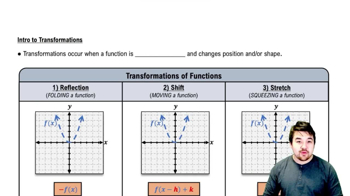
Function transformations involve altering the graph of a standard function through operations such as translation, scaling, reflection, and rotation. In the given problem, transformations help in graphing y = (1/2x) − 1 by scaling the graph of y = x by 1/2 and translating it downwards by 1 unit, without plotting individual points.
Linear functions are represented by equations of the form y = mx + b, where m is the slope and b is the y-intercept. They produce straight-line graphs. In the problem, y = (1/2)x − 1 is a linear function with a slope of 1/2, indicating a less steep incline compared to y = x, and a y-intercept of -1, shifting the graph downward.