a. Use a graphing utility to sketch the graph of y = coth x and then explain why ∫₅¹⁰ coth x dx ≈ 5.
Verified step by step guidance
1
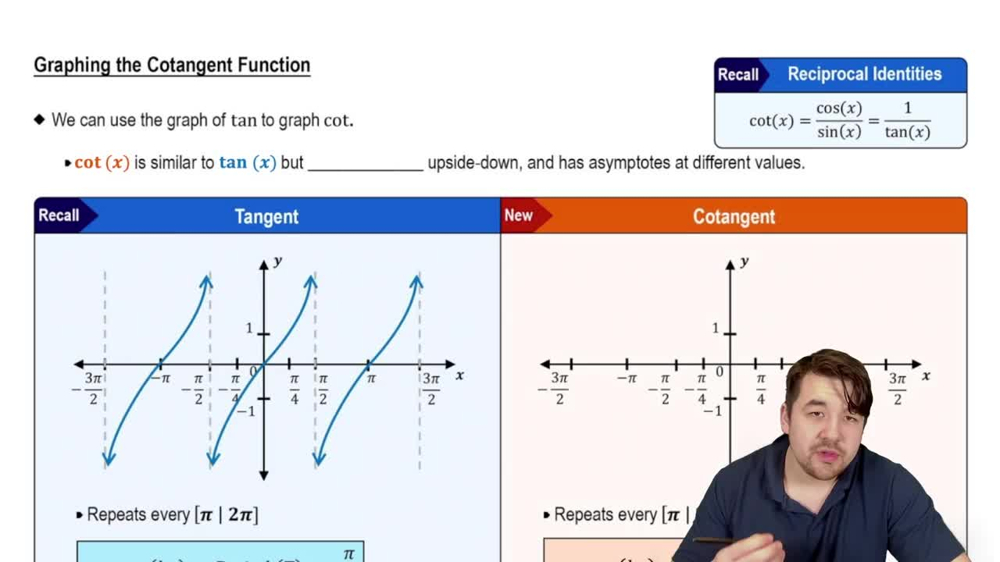
Recall the definition of the hyperbolic cotangent function: \(y = \coth x = \frac{\cosh x}{\sinh x}\), where \(\sinh x\) and \(\cosh x\) are the hyperbolic sine and cosine functions respectively.
Use a graphing utility to plot the function \(y = \coth x\) over the interval \([5, 10]\). Observe the behavior of the graph in this range, noting that \(\coth x\) approaches 1 as \(x\) becomes large.
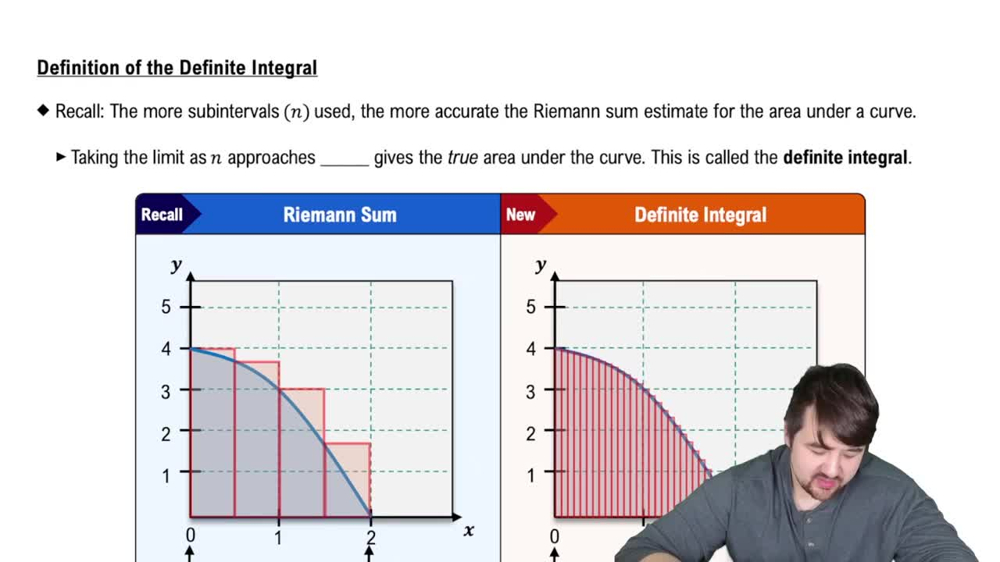
Understand that the definite integral \(\int_5^{10} \coth x \, dx\) represents the area under the curve of \(y = \coth x\) from \(x=5\) to \(x=10\).
Since \(\coth x\) is close to 1 for large \(x\), the graph between 5 and 10 is near the horizontal line \(y=1\). Therefore, the area under the curve is approximately the area of a rectangle with height 1 and width \$10 - 5 = 5$.
Conclude that this approximation explains why \(\int_5^{10} \coth x \, dx \approx 5\), because the integral sums values close to 1 over an interval of length 5.
Verified video answer for a similar problem:
This video solution was recommended by our tutors as helpful for the problem above
Video duration:
4m
Play a video:
0 Comments
Key Concepts
Here are the essential concepts you must grasp in order to answer the question correctly.
Hyperbolic Cotangent Function (coth x)
The hyperbolic cotangent function, coth x, is defined as cosh x divided by sinh x. It behaves similarly to the reciprocal of the tangent function but for hyperbolic angles. Understanding its shape and asymptotic behavior helps in visualizing the graph and estimating integrals involving coth x.
A definite integral ∫_a^b f(x) dx represents the net area between the graph of f(x) and the x-axis from x = a to x = b. Visualizing this area on the graph of coth x allows approximation of the integral's value by estimating the region's size.
Graphing utilities plot functions accurately, revealing key features like asymptotes and behavior over intervals. By sketching y = coth x from 5 to 10, one can visually assess the area under the curve, supporting an approximate value for the integral without exact calculation.

 4:47 minutes
 Verified step by step guidance
 03:39
03:39