
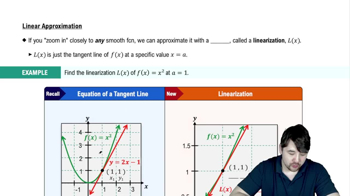
To find the linearization of a function at a given point, we use the formula for the linear approximation: L(x) = f(a) + f'(a)(x - a), where f(x) is the function and a is the point of interest.
First, identify the function f(x) = tan(x) and the point a = -π/4.
Calculate f(a) by evaluating tan(-π/4). Recall that tan(-π/4) = -1.
Next, find the derivative of the function, f'(x) = sec^2(x). Evaluate this derivative at x = -π/4. Since sec(x) = 1/cos(x), and cos(-π/4) = √2/2, we have sec(-π/4) = 2/√2 = √2. Therefore, sec^2(-π/4) = 2.
Substitute f(a) and f'(a) into the linearization formula: L(x) = -1 + 2(x + π/4). This is the linear approximation of tan(x) at x = -π/4. To graph, plot both the curve y = tan(x) and the line y = L(x) on the same set of axes to visualize the approximation.
Verified video answer for a similar problem:
This video solution was recommended by our tutors as helpful for the problem above
Video duration:
4m
Play a video:
Was this helpful?
Key Concepts
Here are the essential concepts you must grasp in order to answer the question correctly.
Linearization
Linearization is the process of approximating a function near a given point using the tangent line at that point. The linearization of a function f(x) at x = a is given by L(x) = f(a) + f'(a)(x - a). This provides a simple linear model that approximates the function's behavior near x = a.
Understanding the derivative of trigonometric functions is crucial for linearization. For the function tan(x), the derivative is sec^2(x). This derivative is used to find the slope of the tangent line, which is essential for constructing the linear approximation at a specific point.
Graphing both the original function and its linear approximation helps visualize how well the linearization approximates the function near the point of tangency. It involves plotting the function, the tangent line, and observing their behavior around the point of interest, which in this case is x = -π/4.