1. Give some examples of analytical methods for evaluating integrals.
Verified step by step guidance
1
Understand that analytical methods for evaluating integrals involve finding exact solutions using mathematical techniques, as opposed to numerical approximations.
One common method is the **Power Rule for Integration**, which states that for any function of the form \( \int x^n \, dx \), the result is \( \frac{x^{n+1}}{n+1} + C \), where \( n \neq -1 \).
Another method is **Substitution**, where you simplify the integral by substituting a part of the integrand with a new variable. For example, for \( \int f(g(x))g'(x) \, dx \), let \( u = g(x) \), then \( du = g'(x)dx \).
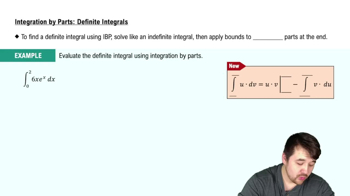
The **Integration by Parts** method is based on the product rule for differentiation and is given by \( \int u \, dv = uv - \int v \, du \). This is useful for integrals involving products of functions.
Finally, **Partial Fraction Decomposition** is used for rational functions. It involves breaking a complex fraction into simpler fractions that can be integrated individually.
Verified video answer for a similar problem:
This video solution was recommended by our tutors as helpful for the problem above
Video duration:
1m
Play a video:
0 Comments
Key Concepts
Here are the essential concepts you must grasp in order to answer the question correctly.
Definite and Indefinite Integrals
Definite integrals calculate the area under a curve between two points, providing a numerical result, while indefinite integrals represent a family of functions whose derivative is the integrand, yielding a general solution plus a constant of integration. Understanding the distinction is crucial for applying the correct analytical methods.
Various techniques exist for evaluating integrals, including substitution, integration by parts, and partial fraction decomposition. Each method is suited for different types of integrands, and knowing when to apply each technique is essential for simplifying complex integrals effectively.
When analytical methods are impractical, numerical integration techniques, such as the Trapezoidal Rule or Simpson's Rule, approximate the value of integrals. These methods are particularly useful for functions that do not have elementary antiderivatives, allowing for practical solutions in applied contexts.