
Textbook Question
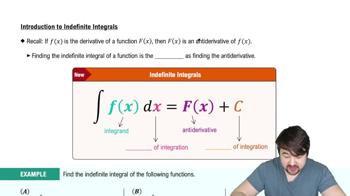
90–103. Indefinite integrals Determine the following indefinite integrals.
∫ ((1/x²) - (2/(x⁵⸍²))) dx
71
views

 Verified step by step guidance
 05:04
05:04
 6:04
6:04 05:18
05:1890–103. Indefinite integrals Determine the following indefinite integrals.
∫ ((1/x²) - (2/(x⁵⸍²))) dx
Change in elevation The elevation h (in feet above the ground) of a stone dropped from a height of 1000 ft is modeled by the equation h(t) = 1000 - 16t², where t is measured in seconds and air resistance is neglected. Approximate the change in elevation over the interval 5 ≤ t ≤ 5.7 (recall that Δh ≈ h' (a) Δt).
60–81. Limits Evaluate the following limits. Use l’Hôpital’s Rule when needed.
lim_Θ→0 (3 sin² 2Θ) / Θ²
90–103. Indefinite integrals Determine the following indefinite integrals.
∫(1 + 3 cosΘ) dΘ
60–81. Limits Evaluate the following limits. Use l’Hôpital’s Rule when needed.
lim_Θ→0 2Θ cot 3Θ
24–34. Curve sketching Use the guidelines given in Section 4.4 to make a complete graph of the following functions on their domains or on the given interval. Use a graphing utility to check your work.
ƒ(x) = 10x² / (x² + 3)