
90–103. Indefinite integrals Determine the following indefinite integrals.
∫ (⁴√x³ + √x⁵) dx
Verified step by step guidance
1
Rewrite the integrand to express the terms with fractional exponents. Recall that the nth root of x can be written as x^(1/n). For example, ⁴√x³ becomes x^(3/4) and √x⁵ becomes x^(5/2). The integrand becomes ∫(x^(3/4) + x^(5/2)) dx.
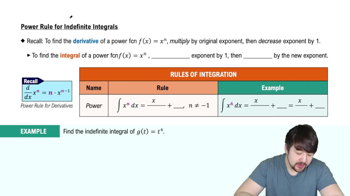
Apply the power rule for integration to each term separately. The power rule states that ∫x^n dx = (x^(n+1))/(n+1) + C, where n ≠ -1.
For the first term x^(3/4), add 1 to the exponent (3/4 + 1 = 7/4) and divide by the new exponent (7/4). The result is (x^(7/4))/(7/4) or (4/7)x^(7/4).
For the second term x^(5/2), add 1 to the exponent (5/2 + 1 = 7/2) and divide by the new exponent (7/2). The result is (x^(7/2))/(7/2) or (2/7)x^(7/2).
Combine the results from both terms and include the constant of integration C. The indefinite integral is ∫(x^(3/4) + x^(5/2)) dx = (4/7)x^(7/4) + (2/7)x^(7/2) + C.
Verified video answer for a similar problem:
This video solution was recommended by our tutors as helpful for the problem above
Video duration:
1m
Play a video:
0 Comments
Key Concepts
Here are the essential concepts you must grasp in order to answer the question correctly.
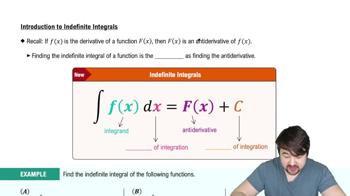
Indefinite Integrals
Indefinite integrals represent a family of functions whose derivative is the integrand. They are expressed without limits and include a constant of integration, typically denoted as 'C'. The process of finding an indefinite integral is often referred to as antiderivation, where we seek a function F(x) such that F'(x) equals the integrand.
The power rule for integration is a fundamental technique used to integrate polynomial functions. It states that for any real number n ≠ -1, the integral of x^n with respect to x is (x^(n+1))/(n+1) + C. This rule simplifies the process of integrating terms like x^3 and x^5, making it essential for solving the given integral.
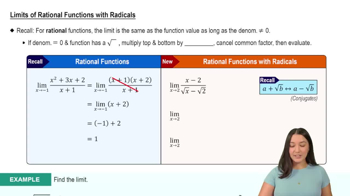
Simplifying radicals involves rewriting expressions with roots in a more manageable form. In the context of the given integral, terms like ⁴√x³ and √x⁵ can be expressed as x^(3/4) and x^(5/2), respectively. This transformation allows for easier application of integration techniques, particularly the power rule.