Average value of the derivative Suppose ƒ ' is a continuous function for all real numbers. Show that the average value of the derivative on an interval [a, b] is ƒ⁻' = (ƒ(b) ―ƒ(a))/ (b―a) . Interpret this result in terms of secant lines.
Table of contents
- 0. Functions7h 54m
- Introduction to Functions16m
- Piecewise Functions10m
- Properties of Functions9m
- Common Functions1h 8m
- Transformations5m
- Combining Functions27m
- Exponent rules32m
- Exponential Functions28m
- Logarithmic Functions24m
- Properties of Logarithms36m
- Exponential & Logarithmic Equations35m
- Introduction to Trigonometric Functions38m
- Graphs of Trigonometric Functions44m
- Trigonometric Identities47m
- Inverse Trigonometric Functions48m
- 1. Limits and Continuity2h 2m
- 2. Intro to Derivatives1h 33m
- 3. Techniques of Differentiation3h 18m
- 4. Applications of Derivatives2h 38m
- 5. Graphical Applications of Derivatives6h 2m
- 6. Derivatives of Inverse, Exponential, & Logarithmic Functions2h 37m
- 7. Antiderivatives & Indefinite Integrals1h 26m
- 8. Definite Integrals4h 44m
- 9. Graphical Applications of Integrals2h 27m
- 10. Physics Applications of Integrals 3h 16m
- 11. Integrals of Inverse, Exponential, & Logarithmic Functions2h 34m
- 12. Techniques of Integration7h 41m
- 13. Intro to Differential Equations2h 55m
- 14. Sequences & Series5h 36m
- 15. Power Series2h 19m
- 16. Parametric Equations & Polar Coordinates7h 58m
8. Definite Integrals
Average Value of a Function
Problem 5.4.58a
Textbook Question
Bounds on an integral Suppose ƒ is continuous on [a, b] with ƒ''(𝓍) > 0 on the interval. It can be shown that (b―a) ƒ [(a + b) /2] ≤ ∫ₐᵇ ƒ(𝓍) d𝓍 ≤ (b―a) [ (ƒ(a) + ƒ(b)) /2]
(a) Assuming ƒ is nonnegative on [a, b], draw a figure to illustrate the geometric meaning of these inequalities. Discuss your conclusions. b.
Verified step by step guidance1
Step 1: Understand the given inequality. Since \( f''(x) > 0 \) on \([a, b]\), the function \( f \) is convex on this interval. The inequality states that:
\[
(b - a) f\left(\frac{a + b}{2}\right) \leq \int_a^b f(x) \, dx \leq (b - a) \frac{f(a) + f(b)}{2}
\]
This means the integral of \( f \) over \([a, b]\) is bounded below by the area of a rectangle with height \( f \) at the midpoint, and above by the area of a trapezoid formed by the values at the endpoints.
Step 2: Sketch the graph of \( f \) on the interval \([a, b]\). Since \( f \) is convex, the curve lies below the line segment connecting \( (a, f(a)) \) and \( (b, f(b)) \). Mark the points \( (a, f(a)) \), \( (b, f(b)) \), and the midpoint \( \left(\frac{a+b}{2}, f\left(\frac{a+b}{2}\right)\right) \).
Step 3: Illustrate the lower bound: draw a rectangle with base \( (b - a) \) and height \( f\left(\frac{a+b}{2}\right) \). This rectangle represents the quantity \( (b - a) f\left(\frac{a+b}{2}\right) \), which is less than or equal to the integral.
Step 4: Illustrate the upper bound: draw the trapezoid formed by the points \( (a, 0) \), \( (a, f(a)) \), \( (b, f(b)) \), and \( (b, 0) \). The area of this trapezoid is \( (b - a) \frac{f(a) + f(b)}{2} \), which is greater than or equal to the integral.
Step 5: Discuss conclusions: Since \( f \) is convex and nonnegative, the integral (area under the curve) lies between the area of the midpoint rectangle and the trapezoid formed by the endpoints. This reflects how convexity controls the shape of \( f \) and provides useful bounds for the integral.
Verified video answer for a similar problem:This video solution was recommended by our tutors as helpful for the problem above
Video duration:
2mPlay a video:
Was this helpful?
Key Concepts
Here are the essential concepts you must grasp in order to answer the question correctly.
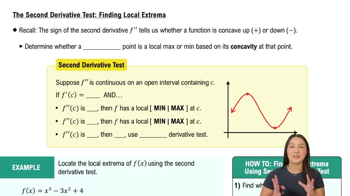
Convexity and the Second Derivative Test
A function ƒ is convex on [a, b] if its second derivative ƒ''(x) is positive throughout the interval. This means the graph of ƒ lies below any chord connecting two points on the curve. Convexity ensures certain inequalities hold for integrals and averages of the function values.
Recommended video:
The Second Derivative Test: Finding Local Extrema
Integral Bounds and the Midpoint and Trapezoidal Approximations
The integral of ƒ over [a, b] can be bounded using the midpoint rule (evaluating ƒ at (a+b)/2) and the trapezoidal rule (averaging ƒ(a) and ƒ(b)). For convex functions, the midpoint approximation underestimates the integral, while the trapezoidal approximation overestimates it, providing useful bounds.
Recommended video:
Integration by Parts for Definite Integrals
Geometric Interpretation of Integral Inequalities
The inequalities relate areas under the curve to areas of simple geometric shapes: a rectangle at the midpoint and a trapezoid formed by endpoints. For a convex function, the curve lies below the trapezoid and above the midpoint rectangle, visually explaining why the integral is bounded between these two approximations.
Recommended video:
Guided course
Geometric Sequences - Recursive Formula
Watch next
Master Average Value of a Function with a bite sized video explanation from Patrick
Start learningRelated Videos
Related Practice
Textbook Question
24
views