Probability: tossing for a head The expected (average) number of tosses of a fair coin required to obtain the first head is ∑ₖ₌₁∞ k(1/2)ᵏ. Evaluate this series and determine the expected number of tosses. (Hint: Differentiate a geometric series.)
Table of contents
- 0. Functions7h 54m
- Introduction to Functions16m
- Piecewise Functions10m
- Properties of Functions9m
- Common Functions1h 8m
- Transformations5m
- Combining Functions27m
- Exponent rules32m
- Exponential Functions28m
- Logarithmic Functions24m
- Properties of Logarithms36m
- Exponential & Logarithmic Equations35m
- Introduction to Trigonometric Functions38m
- Graphs of Trigonometric Functions44m
- Trigonometric Identities47m
- Inverse Trigonometric Functions48m
- 1. Limits and Continuity2h 2m
- 2. Intro to Derivatives1h 33m
- 3. Techniques of Differentiation3h 18m
- 4. Applications of Derivatives2h 38m
- 5. Graphical Applications of Derivatives6h 2m
- 6. Derivatives of Inverse, Exponential, & Logarithmic Functions2h 37m
- 7. Antiderivatives & Indefinite Integrals1h 26m
- 8. Definite Integrals4h 44m
- 9. Graphical Applications of Integrals2h 27m
- 10. Physics Applications of Integrals 3h 16m
- 11. Integrals of Inverse, Exponential, & Logarithmic Functions2h 34m
- 12. Techniques of Integration7h 41m
- 13. Intro to Differential Equations2h 55m
- 14. Sequences & Series5h 36m
- 15. Power Series2h 19m
- 16. Parametric Equations & Polar Coordinates7h 58m
15. Power Series
Taylor Series & Taylor Polynomials
Problem 11.4.54
Textbook Question
Evaluating an infinite series Write the Maclaurin series for f(x) = ln (1+x) and find the interval of convergence. Evaluate f(−1/2) to find the value of ∑ₖ₌₁∞ 1/(k 2ᵏ)
Verified step by step guidance1
Recall that the Maclaurin series for a function \( f(x) \) is its Taylor series expansion at \( x = 0 \), given by \( f(x) = \sum_{n=0}^\infty \frac{f^{(n)}(0)}{n!} x^n \). For \( f(x) = \ln(1+x) \), start by finding the derivatives and evaluating them at 0 to identify the pattern of coefficients.
Use the known Maclaurin series expansion for \( \ln(1+x) \), which is \( \ln(1+x) = \sum_{k=1}^\infty (-1)^{k+1} \frac{x^k}{k} \). This series converges for \( -1 < x \leq 1 \).
Determine the interval of convergence by applying the ratio test or by recalling the domain of the logarithm series. The series converges when \( |x| < 1 \) and conditionally at \( x = 1 \), but diverges at \( x = -1 \).
To evaluate \( f(-\frac{1}{2}) = \ln(1 - \frac{1}{2}) = \ln(\frac{1}{2}) \), substitute \( x = -\frac{1}{2} \) into the series: \( \ln(1 - \frac{1}{2}) = \sum_{k=1}^\infty (-1)^{k+1} \frac{(-\frac{1}{2})^k}{k} \). Simplify the powers and signs to express the sum in terms of \( \sum_{k=1}^\infty \frac{1}{k 2^k} \).
Recognize that the series \( \sum_{k=1}^\infty \frac{1}{k 2^k} \) corresponds to the negative of the evaluated series (due to the alternating signs), so rearrange the expression to isolate \( \sum_{k=1}^\infty \frac{1}{k 2^k} \) and express it in terms of \( \ln(\frac{1}{2}) \).
Verified video answer for a similar problem:This video solution was recommended by our tutors as helpful for the problem above
Video duration:
7mPlay a video:
Was this helpful?
Key Concepts
Here are the essential concepts you must grasp in order to answer the question correctly.
Maclaurin Series Expansion
The Maclaurin series is a Taylor series expansion of a function about x = 0. It expresses a function as an infinite sum of its derivatives at zero, multiplied by powers of x and divided by factorial terms. For ln(1+x), the series is derived by differentiating and evaluating at zero, providing a polynomial approximation valid near x = 0.
Recommended video:
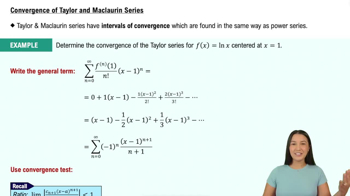
Convergence of Taylor & Maclaurin Series
Interval of Convergence
The interval of convergence defines the range of x-values for which the infinite series converges to the function. It is found using tests like the ratio or root test. For ln(1+x), the series converges when -1 < x ≤ 1, ensuring the series sum accurately represents the function within this domain.
Recommended video:
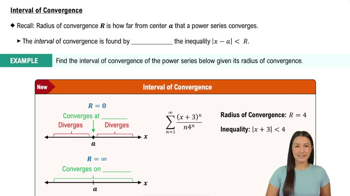
Interval of Convergence
Evaluating Series at Specific Points
Substituting specific values of x into the Maclaurin series allows evaluation of infinite sums related to the function. For example, plugging x = -1/2 into the ln(1+x) series helps find the sum of ∑ₖ₌₁∞ 1/(k 2ᵏ). This technique connects function values to series sums, enabling exact or approximate calculations of infinite series.
Recommended video:
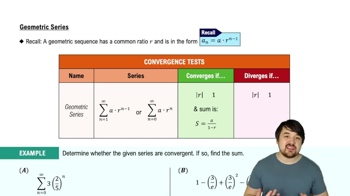
Geometric Series
Related Videos
Related Practice
Textbook Question
5
views