Evaluating an infinite series Let f(x) = (eˣ − 1)/x, for x ≠ 0, and f(0)=1. Use the Taylor series for f centered at 0 to evaluate f(1) and to find the value of ∑ₖ₌₀∞ 1/(k+1)!
Table of contents
- 0. Functions7h 54m
- Introduction to Functions16m
- Piecewise Functions10m
- Properties of Functions9m
- Common Functions1h 8m
- Transformations5m
- Combining Functions27m
- Exponent rules32m
- Exponential Functions28m
- Logarithmic Functions24m
- Properties of Logarithms36m
- Exponential & Logarithmic Equations35m
- Introduction to Trigonometric Functions38m
- Graphs of Trigonometric Functions44m
- Trigonometric Identities47m
- Inverse Trigonometric Functions48m
- 1. Limits and Continuity2h 2m
- 2. Intro to Derivatives1h 33m
- 3. Techniques of Differentiation3h 18m
- 4. Applications of Derivatives2h 38m
- 5. Graphical Applications of Derivatives6h 2m
- 6. Derivatives of Inverse, Exponential, & Logarithmic Functions2h 37m
- 7. Antiderivatives & Indefinite Integrals1h 26m
- 8. Definite Integrals4h 44m
- 9. Graphical Applications of Integrals2h 27m
- 10. Physics Applications of Integrals 3h 16m
- 11. Integrals of Inverse, Exponential, & Logarithmic Functions2h 34m
- 12. Techniques of Integration7h 41m
- 13. Intro to Differential Equations2h 55m
- 14. Sequences & Series5h 36m
- 15. Power Series2h 19m
- 16. Parametric Equations & Polar Coordinates7h 58m
15. Power Series
Taylor Series & Taylor Polynomials
Problem 11.1.33
Textbook Question
{Use of Tech} Approximations with Taylor polynomials
a. Approximate the given quantities using Taylor polynomials with n = 3.
b. Compute the absolute error in the approximation, assuming the exact value is given by a calculator.
e⁰ᐧ¹²
Verified step by step guidance1
Identify the function to approximate: here, the function is \(f(x) = e^x\), and we want to approximate \(e^{0.12}\) using a Taylor polynomial centered at \(x=0\) (Maclaurin polynomial).
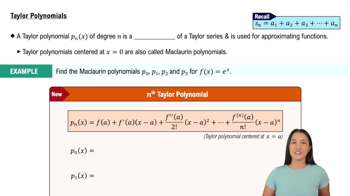
Write the Taylor polynomial of degree 3 for \(f(x) = e^x\) centered at 0. Recall that the Maclaurin series for \(e^x\) is \(\sum_{k=0}^\infty \frac{x^k}{k!}\). The degree 3 polynomial is: \(P_3(x) = 1 + x + \frac{x^2}{2!} + \frac{x^3}{3!}\).
Substitute \(x = 0.12\) into the polynomial \(P_3(x)\) to get the approximation: \(P_3(0.12) = 1 + 0.12 + \frac{(0.12)^2}{2} + \frac{(0.12)^3}{6}\).
Calculate the exact value of \(e^{0.12}\) using a calculator or software to have a reference for the true value.
Compute the absolute error by subtracting the approximation from the exact value: \(\text{Absolute Error} = |e^{0.12} - P_3(0.12)|\).
Verified video answer for a similar problem:This video solution was recommended by our tutors as helpful for the problem above
Video duration:
3mPlay a video:
Was this helpful?
Key Concepts
Here are the essential concepts you must grasp in order to answer the question correctly.
Taylor Polynomials
Taylor polynomials approximate functions near a point by using derivatives at that point. For a function f(x), the nth-degree Taylor polynomial at x = a sums terms involving derivatives of f up to order n, scaled by powers of (x - a). This provides a polynomial approximation that becomes more accurate as n increases.
Recommended video:
Taylor Polynomials
Error and Remainder in Taylor Approximations
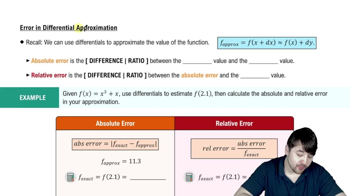
The error in a Taylor polynomial approximation is the difference between the actual function value and the polynomial estimate. The remainder term quantifies this error and can be bounded using higher-order derivatives, helping to assess the accuracy of the approximation.
Recommended video:
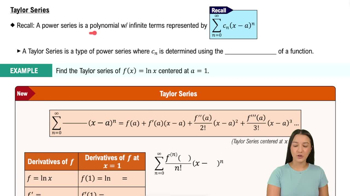
Taylor Series
Absolute Error Calculation
Absolute error measures the magnitude of the difference between an approximate value and the exact value. It is calculated as |approximate value - exact value| and provides a straightforward way to evaluate the precision of numerical approximations.
Recommended video:
Determining Error and Relative Error
Related Videos
Related Practice
Textbook Question
7
views