
Textbook Question
Explain why or why not Determine whether the following statements are true and give an explanation or counterexample.
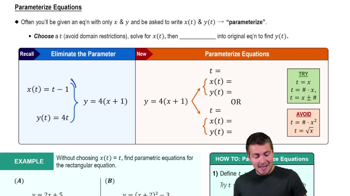
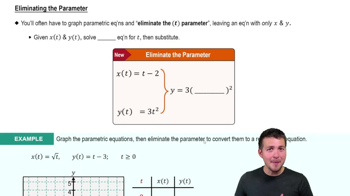
c. The parametric equations x=t, y=t², for t≥0, describe the complete parabola y=x².
31
views

 Verified step by step guidance
 08:02
08:02
 05:59
05:59 11:41
11:41Explain why or why not Determine whether the following statements are true and give an explanation or counterexample.
c. The parametric equations x=t, y=t², for t≥0, describe the complete parabola y=x².
Intersecting lines Consider the following pairs of lines. Determine whether the lines are parallel or intersecting. If the lines intersect, then determine the point of intersection.
b. x = 2 + 5s, y = 1 + s and x = 4 + 10t, y = 3 + 2t
Spiral arc length Consider the spiral r=4θ, for θ≥0.
c. Show that L′(θ)>0. Is L″(θ) positive or negative? Interpret your answer.
11–14. Working with parametric equations Consider the following parametric equations.
c. Eliminate the parameter to obtain an equation in x and y.
d. Describe the curve.
x=2 t,y=3t−4;−10≤t≤10
Intersecting lines Consider the following pairs of lines. Determine whether the lines are parallel or intersecting. If the lines intersect, then determine the point of intersection.
c. x = 1 + 3s, y = 4 + 2s and x = 4 - 3t, y = 6 + 4t
Explain why or why not Determine whether the following statements are true and give an explanation or counterexample.
b. On every ellipse, there are exactly two points at which the curve has slope s, where s is any real number.