
Textbook Question
Limits by power series Use Taylor series to evaluate the following limits.
lim ₙ → ₄ ln (x - 3)/(x² - 16)
93
views

 Verified step by step guidance
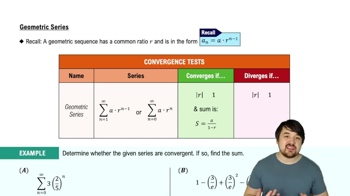
 06:00
06:00
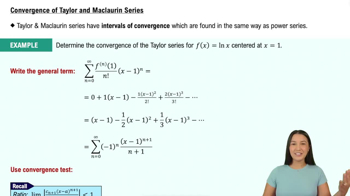 08:26
08:26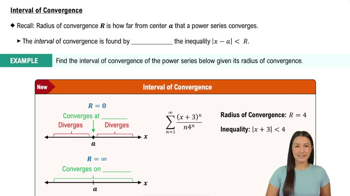 08:44
08:44Limits by power series Use Taylor series to evaluate the following limits.
lim ₙ → ₄ ln (x - 3)/(x² - 16)
Limits by power series Use Taylor series to evaluate the following limits.
lim ₙ → 0 (x²/2 - 1 + cos x)/x⁴
Approximating real numbers Use an appropriate Taylor series to find the first four nonzero terms of an infinite series that is equal to the following numbers. There is more than one way to choose the center of the series.
sinh (-1)
Power series from the geometric series Use the geometric series a Σₖ ₌ ₀ ∞ (x)ᵏ = 1/(1 - x), for |x| < 1, to determine the Maclaurin series and the interval of convergence for the following functions.
ƒ(x) = 1/(1 + 5x)
Taylor polynomials Find the nth-order Taylor polynomial for the following functions centered at the given point a.
ƒ(x) = sinh (-3x), n = 3, a = 0
Power series from the geometric series Use the geometric series a Σₖ ₌ ₀ ∞ (x)ᵏ = 1/(1 - x), for |x| < 1, to determine the Maclaurin series and the interval of convergence for the following functions.
ƒ(x) = ln (1 - 4x)