
Textbook Question
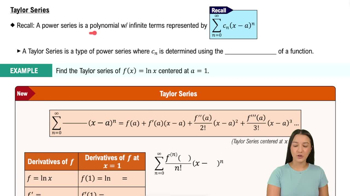
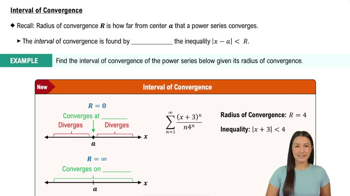
Taylor series and interval of convergence
c. Determine the interval of convergence of the series.
f(x) = 1/x², a=1
73
views

 Verified step by step guidance
 08:42
08:42
 08:44
08:44 5:53
5:53Taylor series and interval of convergence
c. Determine the interval of convergence of the series.
f(x) = 1/x², a=1
Explain why or why not Determine whether the following statements are true and give an explanation or counterexample.
c. Only even powers of x appear in the nth−order Taylor polynomial for f(x)=√(1+x²) centered at 0.
{Use of Tech} Bessel functions Bessel functions arise in the study of wave propagation in circular geometries (for example, waves on a circular drum head). They are conveniently defined as power series. One of an infinite family of Bessel functions is
J₀(x) = ∑ₖ₌₀∞ (−1)ᵏ/(2²ᵏ(k!)²) x²ᵏ
c. Differentiate J₀ twice and show (by keeping terms through x⁶) that J₀ satisfies the equation x² y′′(x) + xy′(x) + x²y(x)=0.
Sine integral function The function Si(x) = ∫₀ˣ f(t) dt, where f(t) = {(sin t)/t if t ≠ 0, 1 if t = 0, is called the sine integral function.
c. Approximate Si(0.5) and Si(1). Use enough terms of the series so the error in the approximation does not exceed 10⁻³.
{Use of Tech} Fresnel integrals The theory of optics gives rise to the two Fresnel integrals
S(x) = ∫₀ˣ sin t² dt and C(x) = ∫₀ˣ cos t² dt
c. Use the polynomials in part (b) to approximate S(0.05) and C(−0.25).
Taylor series and interval of convergence
c. Determine the interval of convergence of the series.
f(x) = e⁻ˣ, a=0