Indefinite integrals Use a change of variables or Table 5.6 to evaluate the following indefinite integrals. Check your work by differentiating. ∫ 2 / (𝓍√4𝓍² ―1) d𝓍 , 𝓍 > ½
Verified step by step guidance
1
Step 1: Recognize that the integral ∫ 2 / (𝓍√(4𝓍² − 1)) d𝓍 suggests a substitution method due to the square root and the quadratic expression in the denominator. Let us set u = 2𝓍, which simplifies the quadratic term inside the square root.
Step 2: Differentiate u = 2𝓍 to find du/d𝓍 = 2, or equivalently, du = 2 d𝓍. Substitute this into the integral, replacing 2 d𝓍 with du and adjusting the expression accordingly.
Step 3: Rewrite the integral in terms of u. The substitution u = 2𝓍 transforms the square root term √(4𝓍² − 1) into √(u² − 1). The integral now becomes ∫ 1 / (u√(u² − 1)) du.
Step 4: Recognize that the integral ∫ 1 / (u√(u² − 1)) du matches a standard form from Table 5.6, which is the derivative of the inverse secant function. Specifically, ∫ 1 / (u√(u² − 1)) du = sec⁻¹(u) + C.
Step 5: Substitute back u = 2𝓍 into the result to express the solution in terms of the original variable 𝓍. The final answer is sec⁻¹(2𝓍) + C. Verify the solution by differentiating sec⁻¹(2𝓍) + C to ensure it matches the original integrand.
Verified video answer for a similar problem:
This video solution was recommended by our tutors as helpful for the problem above
Video duration:
3m
Play a video:
Was this helpful?
Key Concepts
Here are the essential concepts you must grasp in order to answer the question correctly.
Indefinite Integrals
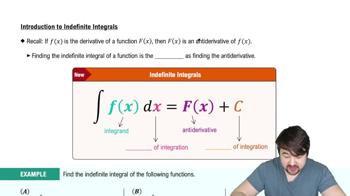
Indefinite integrals represent a family of functions whose derivative gives the integrand. They are expressed in the form ∫f(x)dx = F(x) + C, where F(x) is the antiderivative of f(x) and C is the constant of integration. Understanding indefinite integrals is crucial for solving problems in calculus, as they allow us to find functions from their rates of change.
The change of variables technique, also known as substitution, is a method used in integration to simplify the integrand. By substituting a new variable for a function of the original variable, we can transform the integral into a more manageable form. This technique is particularly useful when dealing with complex expressions, making it easier to evaluate the integral.
Checking work by differentiation involves taking the derivative of the result obtained from an indefinite integral to verify its correctness. If the derivative of the antiderivative matches the original integrand, the solution is confirmed. This step is essential in calculus to ensure that the integration process was performed accurately and to reinforce understanding of the relationship between differentiation and integration.