33–42. Solving initial value problems Solve the following initial value problems. p'(x) = 2/(x² + x), p(1) = 0
Verified step by step guidance
1
Identify the given differential equation and initial condition: \(p'(x) = \frac{2}{x^{2} + x}\) with \(p(1) = 0\).
Rewrite the derivative notation as \(\frac{dp}{dx} = \frac{2}{x^{2} + x}\) to recognize it as a separable differential equation.
Simplify the denominator by factoring: \(x^{2} + x = x(x + 1)\), so the equation becomes \(\frac{dp}{dx} = \frac{2}{x(x + 1)}\).
Integrate both sides with respect to \(x\): \(p(x) = \int \frac{2}{x(x + 1)} \, dx + C\), where \(C\) is the constant of integration.
Use partial fraction decomposition to express \(\frac{2}{x(x + 1)}\) as \(\frac{A}{x} + \frac{B}{x + 1}\), find \(A\) and \(B\), then integrate each term separately. Finally, apply the initial condition \(p(1) = 0\) to solve for \(C\).
Verified video answer for a similar problem:
This video solution was recommended by our tutors as helpful for the problem above
Video duration:
7m
Play a video:
0 Comments
Key Concepts
Here are the essential concepts you must grasp in order to answer the question correctly.
Separable Differential Equations
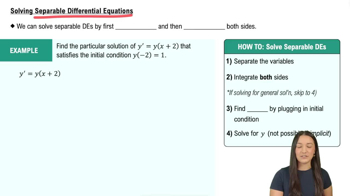
A separable differential equation can be written as a product of a function of x and a function of y, allowing variables to be separated on opposite sides of the equation. This technique simplifies solving by integrating each side independently.
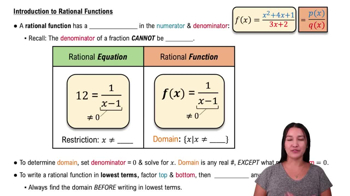
Integrating rational functions often involves techniques like partial fraction decomposition to rewrite the integrand into simpler fractions. This method is essential for integrating expressions like 2/(x² + x) effectively.
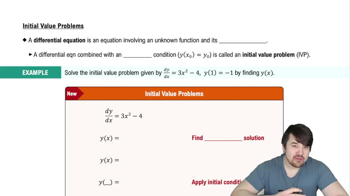
An initial value problem specifies a differential equation along with a condition at a particular point, such as p(1) = 0. Solving an IVP involves finding the general solution and then using the initial condition to determine the specific constant.