In Exercises 41–44, determine whether the piecewise-defined function is differentiable at x = 0.
f(x) = { 2x + tan x, x ≥ 0 x², x < 0
Verified step by step guidance
1
First, check the continuity of the function at x = 0. For the function to be differentiable at a point, it must first be continuous there. Evaluate the left-hand limit and the right-hand limit of f(x) as x approaches 0.
Calculate the left-hand limit: As x approaches 0 from the left (x < 0), f(x) = x². So, the left-hand limit is lim(x→0⁻) x² = 0.
Calculate the right-hand limit: As x approaches 0 from the right (x ≥ 0), f(x) = 2x + tan(x). So, the right-hand limit is lim(x→0⁺) (2x + tan(x)) = 0.
Since both the left-hand and right-hand limits are equal to f(0) = 0, the function is continuous at x = 0.
Next, check the differentiability by finding the derivative from the left and right. For x < 0, the derivative is f'(x) = 2x. For x ≥ 0, the derivative is f'(x) = 2 + sec²(x). Evaluate these derivatives at x = 0 and check if they are equal.
Verified video answer for a similar problem:
This video solution was recommended by our tutors as helpful for the problem above
Video duration:
6m
Play a video:
0 Comments
Key Concepts
Here are the essential concepts you must grasp in order to answer the question correctly.
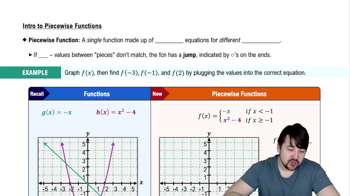
Piecewise Functions
A piecewise function is defined by different expressions based on the input value. In this case, the function f(x) has two distinct definitions: one for x greater than or equal to zero and another for x less than zero. Understanding how to evaluate and analyze these different pieces is crucial for determining properties like continuity and differentiability at specific points.
A function is differentiable at a point if it has a defined derivative at that point, which means the function must be continuous there and the left-hand and right-hand derivatives must be equal. For the given piecewise function, we need to check the behavior of the function as x approaches 0 from both sides to determine if it meets these criteria.
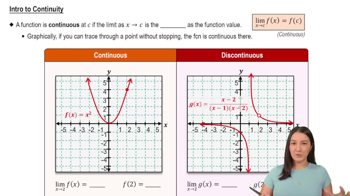
Continuity at a point requires that the function's value at that point equals the limit of the function as it approaches that point from both sides. For the function f(x) at x = 0, we must ensure that the values from both pieces of the function converge to the same point. If the function is not continuous at x = 0, it cannot be differentiable there.