
Ch. 6 - Applications of Integration
Briggs - Calculus: Early Transcendentals 3rd Edition
Briggs3rd EditionCalculus: Early TranscendentalsISBN: 9780136847243Not the one you use?Change textbook
Chapter 6, Problem 6.5.35a

Functions from arc length What differentiable functions have an arc length on the interval [a, b] given by the following integrals? Note that the answers are not unique. Give a family of functions that satisfy the conditions.
a. ∫a^b √1+16x⁴ dx

Verified step by step guidance
1
Recall that the arc length of a function \(y = f(x)\) on the interval \([a, b]\) is given by the integral \(\int_a^b \sqrt{1 + (f'(x))^2} \, dx\).
Compare the given integral \(\int_a^b \sqrt{1 + 16x^4} \, dx\) with the arc length formula. This means that \(\sqrt{1 + (f'(x))^2} = \sqrt{1 + 16x^4}\).
From the equality inside the square roots, deduce that \((f'(x))^2 = 16x^4\).
Take the square root of both sides to find \(f'(x) = \pm 4x^2\).
Integrate \(f'(x)\) to find the family of functions: \(f(x) = \pm \int 4x^2 \, dx = \pm \frac{4}{3} x^3 + C\), where \(C\) is an arbitrary constant.

Verified video answer for a similar problem:

This video solution was recommended by our tutors as helpful for the problem above.
Video duration:
2m
Was this helpful?

Key Concepts

Here are the essential concepts you must grasp in order to answer the question correctly.

Arc Length Formula

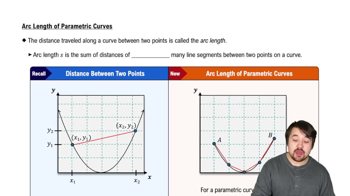
The arc length of a differentiable function y = f(x) over [a, b] is given by the integral ∫_a^b √(1 + (f'(x))²) dx. This formula measures the length of the curve by summing infinitesimal line segments, incorporating the slope of the function through its derivative.
Recommended video:
06:29
Arc Length of Parametric Curves

Relationship Between the Integrand and the Derivative

In the arc length integral, the integrand √(1 + (f'(x))²) reveals how the derivative f'(x) relates to the given expression under the square root. To find functions with a specified arc length integral, one must equate (f'(x))² to the expression inside the integral minus 1 and solve for f'(x).
Recommended video:
05:23
Finding Area Between Curves on a Given Interval

Family of Functions and Integration

Once f'(x) is determined, integrating it yields a family of functions differing by a constant of integration. This reflects the non-uniqueness of solutions, as any vertical shift of the function preserves the same derivative and thus the same arc length integral.
Recommended video:
05:11
Integrals of General Exponential Functions
Related Practice
Textbook Question

Volume of a sphere Let R be the region bounded by the upper half of the circle x²+y² = r² and the x-axis. A sphere of radius r is obtained by revolving R about the x-axis.


a. Use the shell method to verify that the volume of a sphere of radius r is 4/3 πr³.

70
views
Textbook Question

13–16. Displacement from velocity Consider an object moving along a line with the given velocity v. Assume time t is measured in seconds and velocities have units of m/s.


a. Determine when the motion is in the positive direction and when it is in the negative direction. 


v(t) = 50e^−2t on [0, 4]

35
views
Textbook Question

21–30. {Use of Tech} Arc length by calculator


a. Write and simplify the integral that gives the arc length of the following curves on the given interval. 

y = 1/x, for 1 ≤ x ≤ 10

59
views
Textbook Question

Explain why or why not Determine whether the following statements are true and give an explanation or counterexample.


a. The distance traveled by an object moving along a line is the same as the displacement of the object.

44
views
Textbook Question

Let R be the region in the first quadrant bounded above by the curve y=2−x² and bounded below by the line y=x. Suppose the shell method is used to determine the volume of the solid generated by revolving R about the y-axis.

a. What is the radius of a cylindrical shell at a point x in [0, 2]?

70
views
Textbook Question

A right circular cylinder with height R and radius R has a volume of VC=πR^3 (height = radius).


a. Find the volume of the cone that is inscribed in the cylinder with the same base as the cylinder and height R. Express the volume in terms of VC.

87
views