2–74. Integration techniques Use the methods introduced in Sections 8.1 through 8.5 to evaluate the following integrals. 68. ∫ (from -1 to 1) dx/(x² + 2x + 5)
Verified step by step guidance
1
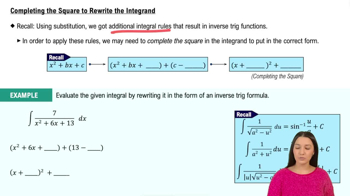
Step 1: Recognize that the denominator x² + 2x + 5 is a quadratic expression. To simplify the integral, complete the square for the quadratic expression. Rewrite x² + 2x + 5 as (x + 1)² + 4.
Step 2: Substitute u = x + 1 to simplify the integral. This substitution shifts the variable, making the integral easier to evaluate. Replace dx with du, and adjust the limits of integration accordingly: when x = -1, u = 0; when x = 1, u = 2.
Step 3: After substitution, the integral becomes ∫ (from 0 to 2) du / (u² + 4). Recognize that this is a standard integral form for arctangent: ∫ du / (u² + a²) = (1/a) * arctan(u/a) + C.
Step 4: Apply the formula for the arctangent integral. Here, a² = 4, so a = 2. The integral becomes (1/2) * arctan(u/2), evaluated from u = 0 to u = 2.
Step 5: Substitute the limits of integration into the result from Step 4. Compute the difference between the arctangent values at the upper and lower limits to finalize the solution.
Verified video answer for a similar problem:
This video solution was recommended by our tutors as helpful for the problem above
Video duration:
4m
Play a video:
0 Comments
Key Concepts
Here are the essential concepts you must grasp in order to answer the question correctly.
Integration Techniques
Integration techniques are methods used to find the integral of a function. Common techniques include substitution, integration by parts, and partial fraction decomposition. Understanding these methods is crucial for evaluating complex integrals, as they allow for simplification and manipulation of the integrand to make integration feasible.
A definite integral represents the signed area under a curve between two specified limits. It is denoted as ∫ from a to b f(x) dx, where 'a' and 'b' are the limits of integration. Evaluating a definite integral involves finding the antiderivative of the function and then applying the Fundamental Theorem of Calculus to compute the difference between the values at the upper and lower limits.
Completing the square is a technique used to transform a quadratic expression into a perfect square trinomial. This method is particularly useful in integrals involving quadratic polynomials, as it simplifies the integrand into a form that is easier to integrate, often leading to a standard integral form that can be directly evaluated.