Ch. 10 - Sequences and Infinite Series
Briggs - Calculus: Early Transcendentals 3rd Edition
Briggs3rd EditionCalculus: Early TranscendentalsISBN: 9780136847243Not the one you use?Change textbook
Chapter 10, Problem 10.4.15

9–16. Divergence Test Use the Divergence Test to determine whether the following series diverge or state that the test is inconclusive.
∑ (k = 2 to ∞) √k / (ln¹⁰ k)

Verified step by step guidance
1
Identify the general term of the series: \( a_k = \frac{\sqrt{k}}{(\ln k)^{10}} \) for \( k \geq 2 \).
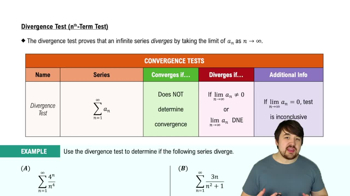
Recall the Divergence Test (also known as the Test for Divergence): if \( \lim_{k \to \infty} a_k \neq 0 \), then the series \( \sum a_k \) diverges. If the limit equals zero, the test is inconclusive.
Calculate the limit \( \lim_{k \to \infty} \frac{\sqrt{k}}{(\ln k)^{10}} \). Consider the growth rates of the numerator and denominator: \( \sqrt{k} = k^{1/2} \) grows faster than any power of \( \ln k \).
Since \( k^{1/2} \) grows faster than \( (\ln k)^{10} \), the fraction \( \frac{\sqrt{k}}{(\ln k)^{10}} \) tends to infinity as \( k \to \infty \), so the limit does not equal zero.
Conclude that by the Divergence Test, because the limit of \( a_k \) is not zero, the series \( \sum_{k=2}^\infty \frac{\sqrt{k}}{(\ln k)^{10}} \) diverges.

Verified video answer for a similar problem:

This video solution was recommended by our tutors as helpful for the problem above.
Video duration:
3m
Was this helpful?

Key Concepts

Here are the essential concepts you must grasp in order to answer the question correctly.

Divergence Test (Nth-Term Test)

The Divergence Test states that if the limit of the terms of a series does not approach zero as n approaches infinity, the series diverges. If the limit is zero, the test is inconclusive, and other methods must be used to determine convergence or divergence.
Recommended video:
05:44
Divergence Test (nth Term Test)

Behavior of the General Term

Analyzing the general term √k / (ln k)¹⁰ involves understanding how the numerator and denominator grow as k increases. Since √k grows faster than any power of ln k, the term's limit as k approaches infinity is crucial for applying the Divergence Test.
Recommended video:
05:44
Divergence Test (nth Term Test)

Logarithmic and Root Functions Growth Rates

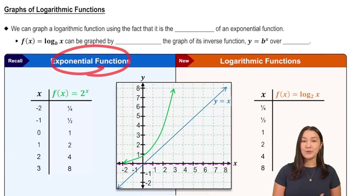
Logarithmic functions grow slower than polynomial functions like square roots. Recognizing that √k increases faster than (ln k)¹⁰ helps determine the limit of the term, which is essential for deciding if the series terms approach zero or not.
Recommended video:
5:26
Graphs of Logarithmic Functions