Estimate the value of the series ∑ (from k = 1 to ∞)1 / (2k + 5)³ to within 10⁻⁴ of its exact value.
Table of contents
- 0. Functions7h 54m
- Introduction to Functions16m
- Piecewise Functions10m
- Properties of Functions9m
- Common Functions1h 8m
- Transformations5m
- Combining Functions27m
- Exponent rules32m
- Exponential Functions28m
- Logarithmic Functions24m
- Properties of Logarithms36m
- Exponential & Logarithmic Equations35m
- Introduction to Trigonometric Functions38m
- Graphs of Trigonometric Functions44m
- Trigonometric Identities47m
- Inverse Trigonometric Functions48m
- 1. Limits and Continuity2h 2m
- 2. Intro to Derivatives1h 33m
- 3. Techniques of Differentiation3h 18m
- 4. Applications of Derivatives2h 38m
- 5. Graphical Applications of Derivatives6h 2m
- 6. Derivatives of Inverse, Exponential, & Logarithmic Functions2h 37m
- 7. Antiderivatives & Indefinite Integrals1h 26m
- 8. Definite Integrals4h 44m
- 9. Graphical Applications of Integrals2h 27m
- 10. Physics Applications of Integrals 3h 16m
- 11. Integrals of Inverse, Exponential, & Logarithmic Functions2h 34m
- 12. Techniques of Integration7h 41m
- 13. Intro to Differential Equations2h 55m
- 14. Sequences & Series5h 36m
- 15. Power Series2h 19m
- 16. Parametric Equations & Polar Coordinates7h 58m
14. Sequences & Series
Series
Problem 11.4.76b
Textbook Question
Probability: sudden−death playoff Teams A and B go into suddendeath overtime after playing to a tie. The teams alternate possession of the ball, and the first team to score wins. Assume each team has a 1/6 chance of scoring when it has the ball, and Team A has the ball first.
b. The expected number of rounds (possessions by either team) required for the overtime to end is (1/6) ∑ₖ₌₁∞ k(5/6)ᵏ⁻¹. Evaluate this series.
Verified step by step guidance1
Recognize that the series given is of the form \(\sum_{k=1}^\infty k r^{k-1}\) where \(r = \frac{5}{6}\). This is a standard series related to the expected value of a geometric distribution.
Recall the formula for the sum of the series \(\sum_{k=1}^\infty k r^{k-1} = \frac{1}{(1-r)^2}\) for \(|r| < 1\).
Substitute \(r = \frac{5}{6}\) into the formula to get \(\sum_{k=1}^\infty k \left(\frac{5}{6}\right)^{k-1} = \frac{1}{\left(1 - \frac{5}{6}\right)^2}\).
Simplify the denominator: \$1 - \frac{5}{6} = \frac{1}{6}\(, so the sum becomes \)\frac{1}{\left(\frac{1}{6}\right)^2}$.
Calculate the final expression for the sum as \(\frac{1}{\left(\frac{1}{6}\right)^2} = 36\), then multiply by the outside factor \(\frac{1}{6}\) to find the expected number of rounds.
Verified video answer for a similar problem:This video solution was recommended by our tutors as helpful for the problem above
Video duration:
4mPlay a video:
Was this helpful?
Key Concepts
Here are the essential concepts you must grasp in order to answer the question correctly.
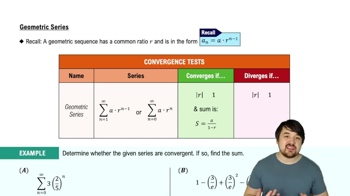
Geometric Series
A geometric series is a sum of terms where each term is a constant multiple (common ratio) of the previous one. It converges if the absolute value of the ratio is less than 1, and its sum can be found using a formula. Understanding geometric series helps evaluate infinite sums like ∑ k r^(k-1).
Recommended video:
Geometric Series
Expected Value of a Discrete Random Variable
The expected value is the weighted average of all possible outcomes, where weights are their probabilities. For a discrete variable representing the number of trials until success, the expected value can be expressed as a sum involving k and the probability of success/failure, often linked to geometric distributions.
Recommended video:
Average Value of a Function
Sum of k times r^(k-1) for |r|<1
The series ∑ k r^(k-1) for |r|<1 has a closed-form sum equal to 1/(1-r)^2. This formula is derived by differentiating the sum of a geometric series and is essential for evaluating expected values in problems involving geometric probabilities.
Recommended video:
Left, Right, & Midpoint Riemann Sums Example 1
Watch next
Master Intro to Series: Partial Sums with a bite sized video explanation from Patrick
Start learningRelated Videos
Related Practice
Textbook Question
8
views