
Ch. 4 - Applications of the Derivative
Briggs - Calculus: Early Transcendentals 3rd Edition
Briggs3rd EditionCalculus: Early TranscendentalsISBN: 9780136847243Not the one you use?Change textbook
Chapter 4, Problem 4.9.23

23–68. Indefinite integrals Determine the following indefinite integrals. Check your work by differentiation.


∫ (3x⁵ - 5x⁹) dx

Verified step by step guidance
1
Step 1: Recall the power rule for integration, which states that for any term xⁿ, the integral is ∫xⁿ dx = (xⁿ⁺¹)/(n+1) + C, where C is the constant of integration.
Step 2: Apply the power rule to each term in the integrand separately. For the term 3x⁵, integrate it as (3 * x⁶)/6. For the term -5x⁹, integrate it as (-5 * x¹⁰)/10.
Step 3: Combine the results from Step 2 into a single expression: (3x⁶)/6 - (5x¹⁰)/10 + C.
Step 4: Simplify the coefficients in the expression. For example, (3x⁶)/6 simplifies to x⁶/2, and (-5x¹⁰)/10 simplifies to -x¹⁰/2.
Step 5: Write the final simplified indefinite integral: x⁶/2 - x¹⁰/2 + C. To check your work, differentiate this expression and verify that it matches the original integrand, 3x⁵ - 5x⁹.

Verified video answer for a similar problem:

This video solution was recommended by our tutors as helpful for the problem above.
Video duration:
2m
Was this helpful?

Key Concepts

Here are the essential concepts you must grasp in order to answer the question correctly.

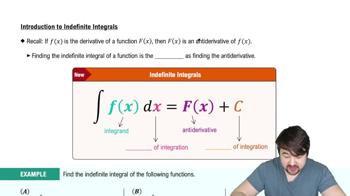
Indefinite Integrals

Indefinite integrals represent a family of functions whose derivative is the integrand. They are expressed without limits and include a constant of integration, typically denoted as 'C'. The process of finding an indefinite integral is essentially the reverse of differentiation, allowing us to recover original functions from their rates of change.
Recommended video:
05:04
Introduction to Indefinite Integrals

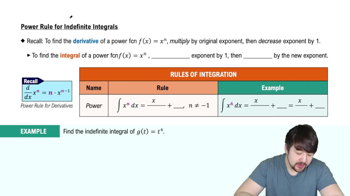
Power Rule for Integration

The power rule for integration is a fundamental technique used to integrate polynomial functions. It states that the integral of x raised to the power n (where n ≠ -1) is (x^(n+1))/(n+1) + C. This rule simplifies the process of finding indefinite integrals of terms like 3x⁵ and -5x⁹ by increasing the exponent and dividing by the new exponent.
Recommended video:
04:04
Power Rule for Indefinite Integrals

Verification by Differentiation

Verification by differentiation involves taking the derivative of the result obtained from an indefinite integral to ensure it matches the original integrand. This step is crucial for confirming the correctness of the integration process, as it provides a check that the integration was performed accurately and that no errors were made in the calculations.
Recommended video:
05:53
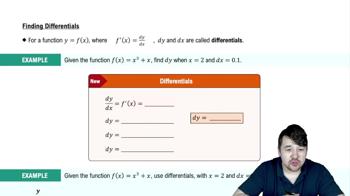
Finding Differentials