Identify the dominant terms in the numerator and denominator of the function \( f(x) = \frac{4x^3 + 1}{1 - x^3} \).
For \( \lim_{x \to \infty} f(x) \), divide both the numerator and the denominator by \( x^3 \), the highest power of \( x \).
Simplify the expression: \( \frac{4 + \frac{1}{x^3}}{\frac{1}{x^3} - 1} \).
Evaluate the limit as \( x \to \infty \): the terms \( \frac{1}{x^3} \) approach zero, simplifying the expression to \( \frac{4}{-1} \).
For \( \lim_{x \to -\infty} f(x) \), repeat the process: divide by \( x^3 \), simplify, and evaluate the limit, noting that the sign of \( x^3 \) changes.
Verified video answer for a similar problem:
This video solution was recommended by our tutors as helpful for the problem above
Video duration:
3m
Play a video:
Was this helpful?
Key Concepts
Here are the essential concepts you must grasp in order to answer the question correctly.
Limits at Infinity
Limits at infinity refer to the behavior of a function as the input approaches positive or negative infinity. This concept helps determine the end behavior of functions, which is crucial for understanding their long-term trends. Evaluating limits at infinity often involves simplifying the function to identify dominant terms that dictate the limit's value.
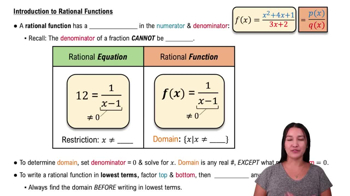
A rational function is a function expressed as the ratio of two polynomials. In the given question, the function f(x) = (4x^3 + 1) / (1 - x^3) is a rational function. Understanding the properties of rational functions, such as their asymptotic behavior and how to simplify them, is essential for evaluating limits at infinity.
Dominant terms in a polynomial are the terms with the highest degree, which significantly influence the function's behavior as x approaches infinity or negative infinity. In the context of limits, identifying these terms allows for simplification of the function, making it easier to evaluate the limit. For rational functions, comparing the degrees of the numerator and denominator is key to finding the limit.