Identify the function for which you need to find the limits: \( f(x) = \frac{6e^{x} + 20}{3e^{x} + 4} \).
To evaluate \( \lim_{x \to \infty} f(x) \), divide the numerator and the denominator by \( e^x \), the highest power of \( e \) in the expression. This simplifies the function to \( \frac{6 + \frac{20}{e^x}}{3 + \frac{4}{e^x}} \).
As \( x \to \infty \), the terms \( \frac{20}{e^x} \) and \( \frac{4}{e^x} \) approach 0 because \( e^x \) grows exponentially. Thus, the expression simplifies to \( \frac{6}{3} \).
Now, evaluate \( \lim_{x \to -\infty} f(x) \). In this case, \( e^x \to 0 \) as \( x \to -\infty \), so the function simplifies to \( \frac{20}{4} \).
Conclude by stating the limits: \( \lim_{x \to \infty} f(x) = 2 \) and \( \lim_{x \to -\infty} f(x) = 5 \).
Verified video answer for a similar problem:
This video solution was recommended by our tutors as helpful for the problem above
Video duration:
3m
Play a video:
Was this helpful?
Key Concepts
Here are the essential concepts you must grasp in order to answer the question correctly.
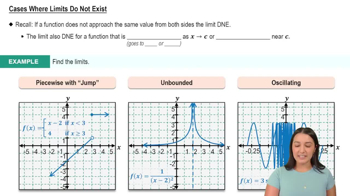
Limits at Infinity
Limits at infinity describe the behavior of a function as the input approaches positive or negative infinity. This concept is crucial for understanding how functions behave in extreme cases, allowing us to determine horizontal asymptotes and the end behavior of functions.
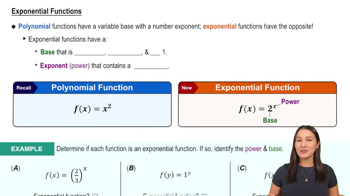
Exponential functions, such as f(x) = (6e^x + 20)/(3e^x + 4), are characterized by a constant base raised to a variable exponent. These functions grow rapidly as x increases, making them essential in calculus for evaluating limits and understanding growth rates.
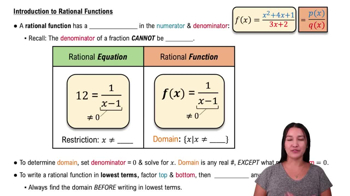
Rational functions are ratios of polynomials, which can exhibit unique behaviors at different values of x. In the context of limits, analyzing the degrees of the numerator and denominator helps determine the limit as x approaches infinity or negative infinity, revealing important characteristics of the function.