What is the polar equation of the vertical line x = 5?
Table of contents
- 0. Functions7h 54m
- Introduction to Functions16m
- Piecewise Functions10m
- Properties of Functions9m
- Common Functions1h 8m
- Transformations5m
- Combining Functions27m
- Exponent rules32m
- Exponential Functions28m
- Logarithmic Functions24m
- Properties of Logarithms36m
- Exponential & Logarithmic Equations35m
- Introduction to Trigonometric Functions38m
- Graphs of Trigonometric Functions44m
- Trigonometric Identities47m
- Inverse Trigonometric Functions48m
- 1. Limits and Continuity2h 2m
- 2. Intro to Derivatives1h 33m
- 3. Techniques of Differentiation3h 18m
- 4. Applications of Derivatives2h 38m
- 5. Graphical Applications of Derivatives6h 2m
- 6. Derivatives of Inverse, Exponential, & Logarithmic Functions2h 37m
- 7. Antiderivatives & Indefinite Integrals1h 26m
- 8. Definite Integrals4h 44m
- 9. Graphical Applications of Integrals2h 27m
- 10. Physics Applications of Integrals 3h 16m
- 11. Integrals of Inverse, Exponential, & Logarithmic Functions2h 34m
- 12. Techniques of Integration7h 41m
- 13. Intro to Differential Equations2h 55m
- 14. Sequences & Series5h 36m
- 15. Power Series2h 19m
- 16. Parametric Equations & Polar Coordinates7h 58m
16. Parametric Equations & Polar Coordinates
Polar Coordinates
Problem 12.R.38
Textbook Question
Cartesian conversion Write the equation x=y ² in polar coordinates and state values of θ that produce the entire graph of the parabola.
Verified step by step guidance1
Recall the relationships between Cartesian coordinates \((x, y)\) and polar coordinates \((r, \theta)\): \(x = r \cos{\theta}\) and \(y = r \sin{\theta}\).
Substitute \(x = r \cos{\theta}\) and \(y = r \sin{\theta}\) into the given equation \(x = y^2\) to get \(r \cos{\theta} = (r \sin{\theta})^2\).
Simplify the right side: \((r \sin{\theta})^2 = r^2 \sin^2{\theta}\), so the equation becomes \(r \cos{\theta} = r^2 \sin^2{\theta}\).
Rearrange the equation to isolate \(r\): \(r^2 \sin^2{\theta} - r \cos{\theta} = 0\), which can be factored as \(r (r \sin^2{\theta} - \cos{\theta}) = 0\).
Solve for \(r\) (ignoring the trivial solution \(r=0\)): \(r = \frac{\cos{\theta}}{\sin^2{\theta}}\). Then, analyze the values of \(\theta\) for which this expression is defined and produces the entire parabola.
Verified video answer for a similar problem:This video solution was recommended by our tutors as helpful for the problem above
Video duration:
3mPlay a video:
Was this helpful?
Key Concepts
Here are the essential concepts you must grasp in order to answer the question correctly.
Polar Coordinates
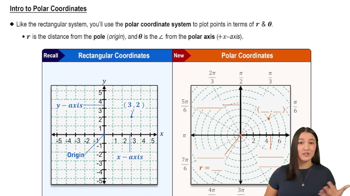
Polar coordinates represent points in the plane using a radius r and an angle θ, where x = r cos θ and y = r sin θ. This system is useful for converting Cartesian equations into forms involving r and θ, facilitating analysis of curves with radial symmetry.
Recommended video:
Intro to Polar Coordinates
Conversion of Cartesian to Polar Equations
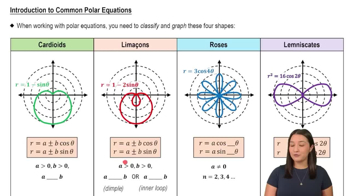
To convert Cartesian equations to polar form, substitute x = r cos θ and y = r sin θ into the equation. This process transforms the equation into one involving r and θ, allowing the curve to be expressed in terms of polar variables.
Recommended video:
Introduction to Common Polar Equations
Domain of θ for Complete Graph Representation
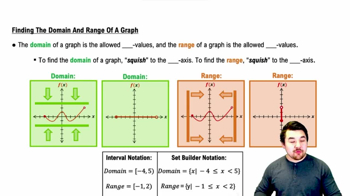
When expressing curves in polar form, the range of θ must be chosen to cover all points of the original graph. Identifying the correct interval for θ ensures the entire curve is traced without omission or repetition.
Recommended video:
Finding the Domain and Range of a Graph
Watch next
Master Intro to Polar Coordinates with a bite sized video explanation from Patrick
Start learningRelated Videos
Related Practice
Textbook Question
8
views