
Express the polar equation r=f(θ) in parametric form in Cartesian coordinates, where θ is the parameter.
Table of contents
- 0. Functions7h 54m
- Introduction to Functions16m
- Piecewise Functions10m
- Properties of Functions9m
- Common Functions1h 8m
- Transformations5m
- Combining Functions27m
- Exponent rules32m
- Exponential Functions28m
- Logarithmic Functions24m
- Properties of Logarithms36m
- Exponential & Logarithmic Equations35m
- Introduction to Trigonometric Functions38m
- Graphs of Trigonometric Functions44m
- Trigonometric Identities47m
- Inverse Trigonometric Functions48m
- 1. Limits and Continuity2h 2m
- 2. Intro to Derivatives1h 33m
- 3. Techniques of Differentiation3h 18m
- 4. Applications of Derivatives2h 38m
- 5. Graphical Applications of Derivatives6h 2m
- 6. Derivatives of Inverse, Exponential, & Logarithmic Functions2h 37m
- 7. Antiderivatives & Indefinite Integrals1h 26m
- 8. Definite Integrals4h 44m
- 9. Graphical Applications of Integrals2h 27m
- 10. Physics Applications of Integrals 3h 16m
- 11. Integrals of Inverse, Exponential, & Logarithmic Functions2h 34m
- 12. Techniques of Integration7h 41m
- 13. Intro to Differential Equations2h 55m
- 14. Sequences & Series5h 36m
- 15. Power Series2h 19m
- 16. Parametric Equations & Polar Coordinates7h 58m
16. Parametric Equations & Polar Coordinates
Polar Coordinates
Problem 12.2.106a
Textbook Question
(Use of Tech) Finger curves: r = f(θ) = cos(aᶿ) - 1.5, where a = (1 + 12π)^(1/(2π)) ≈ 1.78933
a. Show that f(0) = f(2π) and find the point on the curve that corresponds to θ = 0 and θ = 2π.
Verified step by step guidance1
First, write down the given function explicitly: \(r = f(\theta) = \cos(a\theta) - 1.5\), where \(a = (1 + 12\pi)^{\frac{1}{2\pi}}\).
To show that \(f(0) = f(2\pi)\), substitute \(\theta = 0\) into the function: \(f(0) = \cos(a \cdot 0) - 1.5 = \cos(0) - 1.5\).
Next, substitute \(\theta = 2\pi\) into the function: \(f(2\pi) = \cos(a \cdot 2\pi) - 1.5\).
Use the property of the cosine function that \(\cos(\alpha + 2\pi k) = \cos(\alpha)\) for any integer \(k\). Since \(a \cdot 2\pi\) can be expressed in terms of an integer plus a fractional part, analyze \(a \cdot 2\pi\) to see if it corresponds to an integer multiple of \$2\pi$ or how it affects the cosine value.
Finally, find the points on the curve for \(\theta = 0\) and \(\theta = 2\pi\) by converting from polar coordinates \((r, \theta)\) to Cartesian coordinates using \(x = r \cos(\theta)\) and \(y = r \sin(\theta)\) for each value of \(\theta\).
Verified video answer for a similar problem:This video solution was recommended by our tutors as helpful for the problem above
Video duration:
3mPlay a video:
Was this helpful?
Key Concepts
Here are the essential concepts you must grasp in order to answer the question correctly.
Polar Coordinates and Parametric Curves
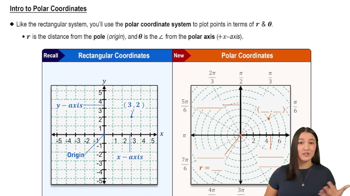
Polar coordinates represent points using a radius r and angle θ, where r = f(θ) defines a curve. Understanding how to interpret and plot points given by r and θ is essential, especially when θ varies over an interval like [0, 2π]. This helps in analyzing the shape and properties of curves defined in polar form.
Recommended video:
Intro to Polar Coordinates
Periodicity and Function Evaluation
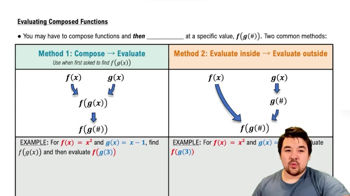
Periodicity refers to a function repeating its values at regular intervals. Showing that f(0) = f(2π) involves evaluating the function at these points and understanding the behavior of trigonometric functions like cosine, which are periodic with period 2π. This concept is key to proving equality and identifying points on the curve.
Recommended video:
Evaluating Composed Functions
Substitution and Simplification of Expressions
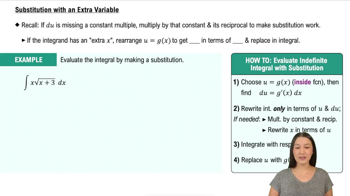
Substitution involves replacing variables with given values to evaluate functions. Simplifying expressions, especially those involving exponents and trigonometric functions, is necessary to find exact values of r at specific θ values. This skill is crucial for determining the coordinates of points on the curve.
Recommended video:
Substitution With an Extra Variable
Watch next
Master Intro to Polar Coordinates with a bite sized video explanation from Patrick
Start learningRelated Videos
Related Practice
Textbook Question
7
views
