Cartesian conversion Write the equation x=y ² in polar coordinates and state values of θ that produce the entire graph of the parabola.
Table of contents
- 0. Functions7h 54m
- Introduction to Functions16m
- Piecewise Functions10m
- Properties of Functions9m
- Common Functions1h 8m
- Transformations5m
- Combining Functions27m
- Exponent rules32m
- Exponential Functions28m
- Logarithmic Functions24m
- Properties of Logarithms36m
- Exponential & Logarithmic Equations35m
- Introduction to Trigonometric Functions38m
- Graphs of Trigonometric Functions44m
- Trigonometric Identities47m
- Inverse Trigonometric Functions48m
- 1. Limits and Continuity2h 2m
- 2. Intro to Derivatives1h 33m
- 3. Techniques of Differentiation3h 18m
- 4. Applications of Derivatives2h 38m
- 5. Graphical Applications of Derivatives6h 2m
- 6. Derivatives of Inverse, Exponential, & Logarithmic Functions2h 37m
- 7. Antiderivatives & Indefinite Integrals1h 26m
- 8. Definite Integrals4h 44m
- 9. Graphical Applications of Integrals2h 27m
- 10. Physics Applications of Integrals 3h 16m
- 11. Integrals of Inverse, Exponential, & Logarithmic Functions2h 34m
- 12. Techniques of Integration7h 41m
- 13. Intro to Differential Equations2h 55m
- 14. Sequences & Series5h 36m
- 15. Power Series2h 19m
- 16. Parametric Equations & Polar Coordinates7h 58m
16. Parametric Equations & Polar Coordinates
Polar Coordinates
Problem 12.R.36a
Textbook Question
Polar conversion Consider the equation r=4/(sinθ+cosθ).
a. Convert the equation to Cartesian coordinates and identify the curve it describes.
Verified step by step guidance1
Recall the relationships between polar and Cartesian coordinates: \(x = r \cos\theta\), \(y = r \sin\theta\), and \(r = \sqrt{x^2 + y^2}\).
Start with the given polar equation: \(r = \frac{4}{\sin\theta + \cos\theta}\).
Multiply both sides of the equation by \((\sin\theta + \cos\theta)\) to get: \(r (\sin\theta + \cos\theta) = 4\).
Substitute \(r \sin\theta = y\) and \(r \cos\theta = x\) into the equation, yielding \(y + x = 4\).
Recognize that the equation \(x + y = 4\) is a linear equation representing a straight line in Cartesian coordinates.
Verified video answer for a similar problem:This video solution was recommended by our tutors as helpful for the problem above
Video duration:
3mPlay a video:
Was this helpful?
Key Concepts
Here are the essential concepts you must grasp in order to answer the question correctly.
Polar to Cartesian Coordinate Conversion
This involves translating equations from polar form (r, θ) to Cartesian form (x, y) using the relationships x = r cosθ and y = r sinθ. Understanding these conversions allows one to rewrite polar equations in terms of x and y, facilitating analysis using familiar Cartesian methods.
Recommended video:
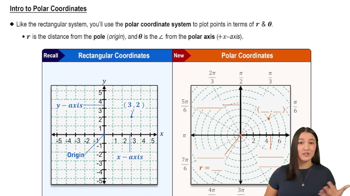
Intro to Polar Coordinates
Trigonometric Identities and Manipulation
Trigonometric identities, such as expressing sinθ and cosθ in terms of x and y, or using sum formulas, are essential for simplifying and rearranging equations during conversion. Mastery of these identities helps in isolating variables and recognizing standard curve forms.
Recommended video:
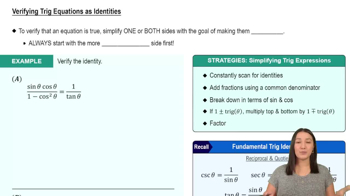
Verifying Trig Equations as Identities
Identification of Conic Sections
After converting to Cartesian form, recognizing the resulting equation as a conic section (circle, ellipse, parabola, or hyperbola) is crucial. This involves comparing the equation to standard forms and understanding geometric properties to classify the curve accurately.
Recommended video:
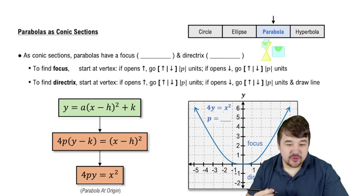
Parabolas as Conic Sections
Watch next
Master Intro to Polar Coordinates with a bite sized video explanation from Patrick
Start learningRelated Videos
Related Practice
Textbook Question
7
views