

Ch. 3 - Derivatives
Hass - Thomas' Calculus 15th Edition
Hass15th EditionThomas' CalculusISBN: 9780137616077Not the one you use?Change textbook
Chapter 3, Problem 3.7.62b

Computer Explorations


Use a CAS to perform the following steps in Exercises 55–62.


b. Using implicit differentiation, find a formula for the derivative dy/dx and evaluate it at the given point P.


x√(1 + 2y) + y = x², P(1,0)

Verified step by step guidance
1
Start by differentiating both sides of the equation with respect to x. The equation is x√(1 + 2y) + y = x².
Apply the product rule to the term x√(1 + 2y). The product rule states that d(uv)/dx = u'v + uv', where u = x and v = √(1 + 2y).
Differentiate u = x to get u' = 1. For v = √(1 + 2y), use the chain rule: v' = (1/2)(1 + 2y)^(-1/2) * (2(dy/dx)).
Combine the derivatives using the product rule: d(x√(1 + 2y))/dx = 1 * √(1 + 2y) + x * (1/2)(1 + 2y)^(-1/2) * 2(dy/dx).
Differentiate the remaining terms: dy/dx for y and 2x for x². Set the derivatives equal: √(1 + 2y) + x(1 + 2y)^(-1/2)(dy/dx) + dy/dx = 2x. Solve for dy/dx and evaluate at P(1,0).

Verified video answer for a similar problem:

This video solution was recommended by our tutors as helpful for the problem above.
Video duration:
6m
Was this helpful?

Key Concepts

Here are the essential concepts you must grasp in order to answer the question correctly.

Implicit Differentiation

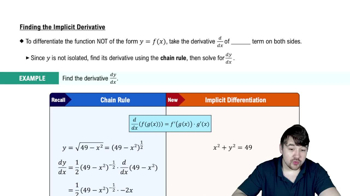
Implicit differentiation is a technique used to find the derivative of a function when it is not explicitly solved for one variable in terms of another. It involves differentiating both sides of an equation with respect to a variable, typically x, while treating other variables as implicit functions of x. This method is essential when dealing with equations like x√(1 + 2y) + y = x², where y is not isolated.
Recommended video:
05:14
Finding The Implicit Derivative

Chain Rule

The chain rule is a fundamental principle in calculus used to differentiate composite functions. It states that the derivative of a composite function is the derivative of the outer function evaluated at the inner function, multiplied by the derivative of the inner function. In implicit differentiation, the chain rule is crucial when differentiating terms involving y, as y is considered a function of x.
Recommended video:
05:02
Intro to the Chain Rule

Evaluating Derivatives at a Point

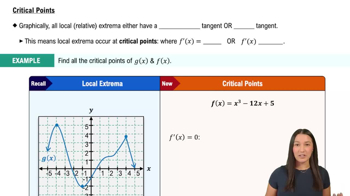
Once the derivative dy/dx is found using implicit differentiation, it can be evaluated at a specific point to find the slope of the tangent line at that point. This involves substituting the coordinates of the given point, such as P(1,0), into the derivative formula. This step is important for understanding the behavior of the function at specific locations on its graph.
Recommended video:
04:50
Critical Points
Related Practice
Textbook Question

Computer Explorations


Use a CAS to perform the following steps in Exercises 55–62.


b. Using implicit differentiation, find a formula for the derivative dy/dx and evaluate it at the given point P.


2y² + (xy)¹/³ = x² + 2, P(1,1)

191
views
Textbook Question

The radius r of a circle is measured with an error of at most 2%. What is the maximum corresponding percentage error in computing the circle’s


b. area?

259
views
Textbook Question

Temperatures in Fairbanks, Alaska The graph in the accompanying figure shows the average Fahrenheit temperature in Fairbanks, Alaska, during a typical 365-day year. The equation that approximates the temperature on day x is


y = 37 sin[(2π/365)(x − 101)] + 25


and is graphed in the accompanying figure.


b. About how many degrees per day is the temperature increasing when it is increasing at its fastest?


" style="max-width: 100%; white-space-collapse: preserve;" width="420">

246
views
Textbook Question

Diagonals If x, y, and z are lengths of the edges of a rectangular box, then the common length of the box’s diagonals is s = √(x² + y² + z²).

b. How is ds/dt related to dy/dt and dz/dt if x is constant?

198
views
Textbook Question

Generalizing the Product Rule The Derivative Product Rule gives the formula


d/dx (uv) = u (dv/dx) + (du/dx) v


for the derivative of the product uv of two differentiable functions of x.


b. What is the formula for the derivative of the product u₁u₂u₃u₄ of four differentiable functions of x?

305
views
Textbook Question

Area The area A of a triangle with sides of lengths a and b enclosing an angle of measure θ is

A = (1/2) ab sinθ.


b. How is dA/dt related to dθ/dt and da/dt if only b is constant?

241
views