

Ch. 4 - Applications of Derivatives
Hass - Thomas' Calculus 15th Edition
Hass15th EditionThomas' CalculusISBN: 9780137616077Not the one you use?Change textbook
Chapter 4, Problem 3.7.53

In Exercises 53 and 54, find both dy/dx (treating y as a differentiable function of x) and dx/dy (treating x as a differentiable function of y). How do dy/dx and dx/dy seem to be related?


53. xy³ + x²y = 6

Verified step by step guidance
1
Step 1: Start by differentiating the equation xy³ + x²y = 6 with respect to x. Use implicit differentiation, treating y as a function of x. Apply the product rule to differentiate terms like xy³ and x²y.
Step 2: For the term xy³, apply the product rule: differentiate x to get 1, multiply by y³, then differentiate y³ with respect to x, which gives 3y²(dy/dx), and multiply by x. Combine these results to get the derivative of xy³.
Step 3: For the term x²y, again use the product rule: differentiate x² to get 2x, multiply by y, then differentiate y with respect to x, which gives (dy/dx), and multiply by x². Combine these results to get the derivative of x²y.
Step 4: Set the derivative of the left side equal to the derivative of the right side, which is 0, since the derivative of a constant is 0. Solve for dy/dx by isolating it on one side of the equation.
Step 5: To find dx/dy, differentiate the original equation with respect to y, treating x as a function of y. Use implicit differentiation and the product rule similarly as before. Solve for dx/dy and observe the relationship between dy/dx and dx/dy, noting that they are reciprocals of each other.

Verified video answer for a similar problem:

This video solution was recommended by our tutors as helpful for the problem above.
Video duration:
7m
Was this helpful?

Key Concepts

Here are the essential concepts you must grasp in order to answer the question correctly.

Implicit Differentiation

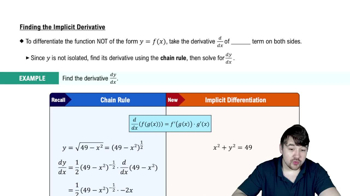
Implicit differentiation is a technique used to find the derivative of a function when it is not explicitly solved for one variable in terms of another. In the equation xy³ + x²y = 6, both x and y are mixed together, so we differentiate both sides with respect to x, treating y as a function of x, and apply the chain rule where necessary.
Recommended video:
05:14
Finding The Implicit Derivative

Chain Rule

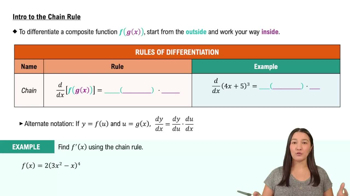
The chain rule is a fundamental principle in calculus used to differentiate composite functions. When applying implicit differentiation, the chain rule helps differentiate terms involving y by multiplying the derivative of y with respect to x (dy/dx). For example, when differentiating y³ with respect to x, we get 3y²(dy/dx).
Recommended video:
05:02
Intro to the Chain Rule

Reciprocal Relationship of Derivatives

The derivatives dy/dx and dx/dy are reciprocals of each other, assuming both exist and are non-zero. This means that if you find dy/dx, you can find dx/dy by taking the reciprocal, and vice versa. This relationship is crucial for understanding how changes in one variable affect the other in implicit functions.
Recommended video:
05:44
Derivatives