
Function defined as an integral Write the integral that gives the length of the curve y = f(x) = ∫₀^x sin t dt on the interval [0,π]
Table of contents
- 0. Functions7h 54m
- Introduction to Functions16m
- Piecewise Functions10m
- Properties of Functions9m
- Common Functions1h 8m
- Transformations5m
- Combining Functions27m
- Exponent rules32m
- Exponential Functions28m
- Logarithmic Functions24m
- Properties of Logarithms36m
- Exponential & Logarithmic Equations35m
- Introduction to Trigonometric Functions38m
- Graphs of Trigonometric Functions44m
- Trigonometric Identities47m
- Inverse Trigonometric Functions48m
- 1. Limits and Continuity2h 2m
- 2. Intro to Derivatives1h 33m
- 3. Techniques of Differentiation3h 18m
- 4. Applications of Derivatives2h 38m
- 5. Graphical Applications of Derivatives6h 2m
- 6. Derivatives of Inverse, Exponential, & Logarithmic Functions2h 37m
- 7. Antiderivatives & Indefinite Integrals1h 26m
- 8. Definite Integrals4h 44m
- 9. Graphical Applications of Integrals2h 27m
- 10. Physics Applications of Integrals 3h 16m
- 11. Integrals of Inverse, Exponential, & Logarithmic Functions2h 34m
- 12. Techniques of Integration7h 41m
- 13. Intro to Differential Equations2h 55m
- 14. Sequences & Series5h 36m
- 15. Power Series2h 19m
- 16. Parametric Equations & Polar Coordinates7h 58m
9. Graphical Applications of Integrals
Introduction to Volume & Disk Method
Problem 6.4.49b
Textbook Question
Volume of a sphere Let R be the region bounded by the upper half of the circle x²+y² = r² and the x-axis. A sphere of radius r is obtained by revolving R about the x-axis.
b. Repeat part (a) using the disk method.
Verified step by step guidance1
Identify the region R bounded by the upper half of the circle \(x^{2} + y^{2} = r^{2}\) and the x-axis. Since it is the upper half, the function describing the curve is \(y = \sqrt{r^{2} - x^{2}}\) for \(x\) in \([-r, r]\).
Set up the volume integral using the disk method. When revolving around the x-axis, the volume is given by \(V = \pi \int_{a}^{b} [f(x)]^{2} \, dx\), where \(f(x)\) is the radius of the disk at position \(x\).
Substitute \(f(x) = \sqrt{r^{2} - x^{2}}\) into the formula, so the volume integral becomes \(V = \pi \int_{-r}^{r} (\sqrt{r^{2} - x^{2}})^{2} \, dx\).
Simplify the integrand: \((\sqrt{r^{2} - x^{2}})^{2} = r^{2} - x^{2}\), so the integral is \(V = \pi \int_{-r}^{r} (r^{2} - x^{2}) \, dx\).
Evaluate the definite integral \(\int_{-r}^{r} (r^{2} - x^{2}) \, dx\) by integrating term-by-term and then multiply the result by \(\pi\) to find the volume of the sphere.
Verified video answer for a similar problem:This video solution was recommended by our tutors as helpful for the problem above
Video duration:
6mPlay a video:
Was this helpful?
Key Concepts
Here are the essential concepts you must grasp in order to answer the question correctly.
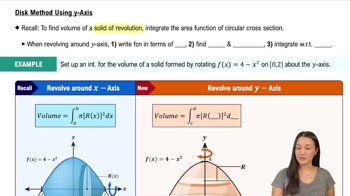
Disk Method
The disk method is a technique for finding the volume of a solid of revolution by slicing the solid perpendicular to the axis of rotation. Each slice forms a disk whose volume is approximated by π(radius)²(thickness). Integrating these volumes over the interval gives the total volume.
Recommended video:
Disk Method Using y-Axis
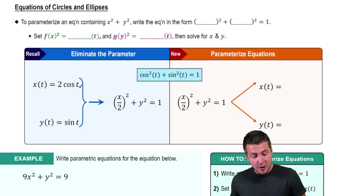
Equation of a Circle and Region Definition
The region R is bounded by the upper half of the circle x² + y² = r² and the x-axis, meaning y = √(r² - x²) for x in [-r, r]. Understanding this curve is essential to set up the integral for the volume calculation.
Recommended video:
Guided course
Parameterizing Equations of Circles & Ellipses
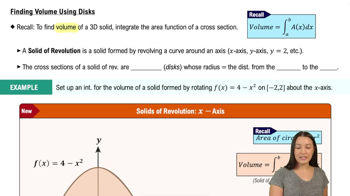
Volume of Revolution about the x-axis
Revolving a region around the x-axis generates a 3D solid. The volume is found by integrating the cross-sectional areas (disks) perpendicular to the x-axis, where each radius corresponds to the y-value of the function defining the region.
Recommended video:
Finding Volume Using Disks
Watch next
Master Introduction to Cross Sections with a bite sized video explanation from Patrick
Start learningRelated Videos
Related Practice
Textbook Question
15
views
