Ch. 6 - Applications of Integration
Briggs - Calculus: Early Transcendentals 3rd Edition
Briggs3rd EditionCalculus: Early TranscendentalsISBN: 9780136847243Not the one you use?Change textbook
Chapter 6, Problem 6.4.51a

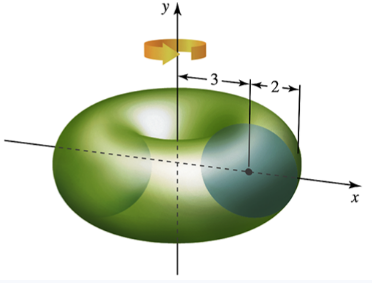
A torus (doughnut) A torus is formed when a circle of radius 2 centered at (3, 0) is revolved about the y-axis.
img


a. Use the shell method to write an integral for the volume of the torus.

Verified step by step guidance
1
Identify the region being revolved: The circle of radius 2 centered at (3, 0) lies in the xy-plane and is revolved about the y-axis to form the torus.
Set up the shell method: Since the axis of revolution is the y-axis (x = 0), use vertical shells parallel to the y-axis. Each shell corresponds to a vertical slice at a particular x-value between the bounds of the circle.
Determine the radius and height of a typical shell: The radius of a shell is the distance from the y-axis, which is simply \(x\). The height of the shell is the vertical length of the circle at that \(x\), which can be found from the circle equation \((x - 3)^2 + y^2 = 2^2\).
Express the height of the shell in terms of \(x\): Solve for \(y\) to get \(y = \pm \sqrt{4 - (x - 3)^2}\). The height of the shell is the difference between the top and bottom, so height \(= 2 \sqrt{4 - (x - 3)^2}\).
Write the integral for the volume using the shell method formula: \(V = \int_{x=a}^{x=b} 2\pi \times (\text{radius}) \times (\text{height}) \, dx = \int_{1}^{5} 2\pi x \cdot 2 \sqrt{4 - (x - 3)^2} \, dx\), where the limits \(x=1\) and \(x=5\) come from the leftmost and rightmost points of the circle.

Verified video answer for a similar problem:

This video solution was recommended by our tutors as helpful for the problem above.
Video duration:
3m
Was this helpful?

Key Concepts

Here are the essential concepts you must grasp in order to answer the question correctly.

Shell Method for Volume

The shell method calculates volume by integrating cylindrical shells formed by revolving a region around an axis. Each shell's volume is approximated by its circumference, height, and thickness. For revolution about the y-axis, shells are vertical slices parallel to the y-axis, with radius equal to the x-value and height given by the function.
Recommended video:
04:48
Finding Volume Using Disks

Equation of the Circle and Region Setup

The torus is generated by revolving a circle of radius 2 centered at (3,0) about the y-axis. The circle's equation is (x-3)^2 + y^2 = 4. Understanding this equation helps determine the height of each shell (the vertical distance between the upper and lower parts of the circle) as a function of x.
Recommended video:
Guided course
06:03
Parameterizing Equations of Circles & Ellipses

Limits of Integration and Variable of Integration

When using the shell method about the y-axis, integration is performed with respect to x, ranging over the interval covering the circle's horizontal extent. Here, x varies from 1 to 5 (center 3 minus radius 2 to center 3 plus radius 2). Correct limits ensure the integral accounts for the entire volume of the torus.
Recommended video:
08:12
Integration by Parts for Definite Integrals Example 7