
27–34. Working with sequences Several terms of a sequence {aₙ}ₙ₌₁∞ are given. c. Find an explicit formula for the nth term of the sequence.
{1, 2, 4, 8, 16, ......}
Verified step by step guidance
1
Identify the pattern in the given sequence: {1, 2, 4, 8, 16, ...}. Notice how each term relates to the previous one.
Observe that each term is obtained by multiplying the previous term by 2. This suggests the sequence is geometric with common ratio r = 2.
Recall the explicit formula for the nth term of a geometric sequence: \(a_n = a_1 \times r^{n-1}\), where \(a_1\) is the first term and \(r\) is the common ratio.
Substitute the known values into the formula: \(a_1 = 1\) and \(r = 2\), so the formula becomes \(a_n = 1 \times 2^{n-1}\).
Simplify the formula to get the explicit nth term: \(a_n = 2^{n-1}\). This formula allows you to find any term in the sequence directly.
Verified video answer for a similar problem:
This video solution was recommended by our tutors as helpful for the problem above
Video duration:
1m
Play a video:
Was this helpful?
Key Concepts
Here are the essential concepts you must grasp in order to answer the question correctly.
Sequences and Terms
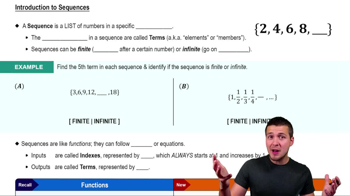
A sequence is an ordered list of numbers defined by a specific rule. Each number in the sequence is called a term, denoted as aₙ, where n indicates the term's position. Understanding how terms progress helps in identifying patterns and formulating explicit expressions.
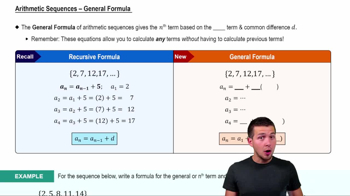
An explicit formula expresses the nth term of a sequence directly in terms of n, allowing calculation of any term without knowing previous terms. For example, geometric sequences have formulas like aₙ = a₁ * r^(n-1), where r is the common ratio.
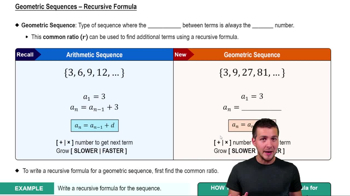
A geometric sequence is one where each term is found by multiplying the previous term by a constant ratio. Recognizing this pattern is key to writing the explicit formula. In the given sequence {1, 2, 4, 8, 16, ...}, the ratio is 2, indicating a geometric progression.