
By computing the first few derivatives and looking for a pattern, find the following derivatives.
c. d⁷³/dx⁷³ (x sin x)
Verified step by step guidance
1
First, identify the function for which you need to find the 73rd derivative: f(x) = x sin(x).
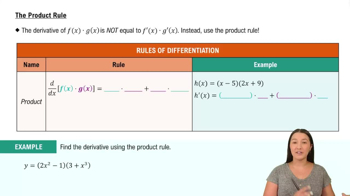
Compute the first derivative using the product rule: d/dx [x sin(x)] = x d/dx[sin(x)] + sin(x) d/dx[x].
The first derivative is: f'(x) = x cos(x) + sin(x).
Compute the second derivative by applying the product rule to each term in f'(x): f''(x) = d/dx[x cos(x)] + d/dx[sin(x)].
Continue finding higher-order derivatives and look for a pattern in the derivatives to generalize the 73rd derivative.
Verified video answer for a similar problem:
This video solution was recommended by our tutors as helpful for the problem above
Video duration:
10m
Play a video:
0 Comments
Key Concepts
Here are the essential concepts you must grasp in order to answer the question correctly.
Product Rule
The product rule is a fundamental technique in calculus used to find the derivative of a product of two functions. If you have two differentiable functions, u(x) and v(x), the derivative of their product is given by (uv)' = u'v + uv'. This rule is essential when differentiating expressions like x sin(x), where both x and sin(x) are functions of x.
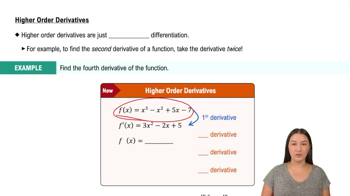
Higher order derivatives refer to the derivatives of a function taken multiple times. For example, the second derivative is the derivative of the derivative, and so on. In this problem, you are asked to find the 73rd derivative, which involves repeatedly applying differentiation rules and identifying any emerging patterns in the derivatives.
When computing higher order derivatives, recognizing patterns can simplify the process. For functions like x sin(x), derivatives often follow a cyclical pattern due to the periodic nature of trigonometric functions. Identifying these patterns allows for efficient computation of derivatives without performing each differentiation step manually.