

Determine values of the constants and , if possible, for which is continuous at .
Verified step by step guidance
1
To ensure the function g(x) is continuous at x = 1, the left-hand limit, right-hand limit, and the value of the function at x = 1 must all be equal.
First, calculate the left-hand limit as x approaches 1. For x < 1, g(x) = 5x - 2. Thus, the left-hand limit is lim_{x \to 1^-} g(x) = 5(1) - 2 = 3.
Next, calculate the right-hand limit as x approaches 1. For x > 1, g(x) = ax^2 + bx. Thus, the right-hand limit is lim_{x \to 1^+} g(x) = a(1)^2 + b(1) = a + b.
The function value at x = 1 is given by g(1) = a.
For g(x) to be continuous at x = 1, set the left-hand limit equal to the right-hand limit and the function value: 3 = a and 3 = a + b. Solve these equations to find the values of a and b.
Verified video answer for a similar problem:
This video solution was recommended by our tutors as helpful for the problem above
Video duration:
4m
Play a video:
Was this helpful?
Key Concepts
Here are the essential concepts you must grasp in order to answer the question correctly.
Piecewise Functions
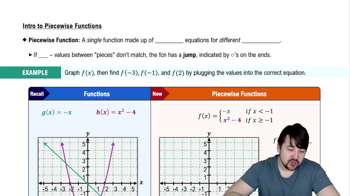
A piecewise function is defined by different expressions based on the input value. In this case, the function g(x) has three distinct cases depending on whether x is less than, equal to, or greater than 1. Understanding how to evaluate and analyze piecewise functions is crucial for determining continuity and limits at specific points.
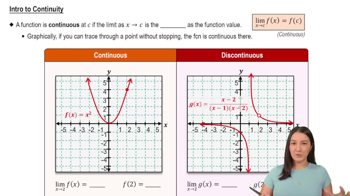
A function is continuous at a point if the limit of the function as it approaches that point equals the function's value at that point. For g(x) to be continuous at x=1, the left-hand limit (as x approaches 1 from the left) must equal the right-hand limit (as x approaches 1 from the right) and also equal g(1). This concept is essential for solving the problem of finding appropriate values for a and b.
Limits describe the behavior of a function as it approaches a certain point. In this context, we need to calculate the limits of g(x) as x approaches 1 from both sides. The values of a and b can be determined by ensuring that these limits match the value of g(1), which is defined as a, thus ensuring the function is continuous at that point.