Suppose the rental cost for a snowboard is \$25 for the first day (or any part of the first day) plus \$15 for each additional day (or any part of a day). e. For what values of t is f continuous? Explain.
Verified step by step guidance
1
Step 1: Understand the function f(t) that represents the rental cost. The function is piecewise, with a fixed cost for the first day and a different rate for additional days.
Step 2: Define the function f(t) as f(t) = 25 for 0 < t ≤ 1 and f(t) = 25 + 15(t - 1) for t > 1, where t is the number of days.
Step 3: Identify the points where the function might be discontinuous. Discontinuities in piecewise functions often occur at the boundaries between pieces, in this case, at t = 1.
Step 4: Check the continuity at t = 1 by evaluating the left-hand limit, right-hand limit, and the value of the function at t = 1. Ensure that these three values are equal for continuity.
Step 5: Conclude that the function f(t) is continuous for all t > 0 except possibly at t = 1, depending on the results of the limits and function value at that point.
Verified video answer for a similar problem:
This video solution was recommended by our tutors as helpful for the problem above
Video duration:
4m
Play a video:
Was this helpful?
Key Concepts
Here are the essential concepts you must grasp in order to answer the question correctly.
Continuity of Functions
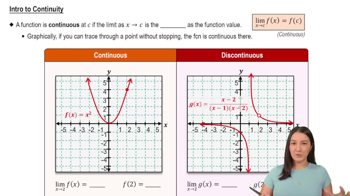
A function is continuous at a point if the limit of the function as it approaches that point equals the function's value at that point. This means there are no breaks, jumps, or holes in the graph of the function at that point. For a function to be continuous over an interval, it must be continuous at every point within that interval.
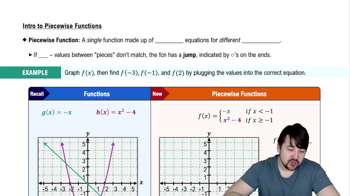
A piecewise function is defined by different expressions based on the input value. In the context of the snowboard rental cost, the function can be expressed in segments: one for the first day and another for subsequent days. Understanding how to analyze these segments is crucial for determining continuity, especially at the boundaries where the function changes.
Limits are fundamental in calculus for understanding the behavior of functions as they approach a certain point. To determine continuity, one must evaluate the left-hand limit and right-hand limit at the point of interest. If both limits exist and are equal to the function's value at that point, the function is continuous there.


 4:25 minutes
 Verified step by step guidance
 05:34
05:34