Ch. 7 - Logarithmic, Exponential Functions, and Hyperbolic Functions
Briggs - Calculus: Early Transcendentals 3rd Edition
Briggs3rd EditionCalculus: Early TranscendentalsISBN: 9780136847243Not the one you use?Change textbook
Chapter 7, Problem 7.1.77

Harmonic sum In Chapter 10, we will encounter the harmonic sum 1 + 1/2 + 1/3 + ⋯ + 1/n. Use a left Riemann sum to approximate ∫[1 to n+1] (dx/x) (with unit spacing between the grid points) to show that 1 + 1/2 + 1/3 + ⋯ + 1/n > ln(n + 1). Use this fact to conclude that lim (n → ∞) (1 + 1/2 + 1/3 + ⋯ + 1/n) does not exist.

Verified step by step guidance
1
Recall that the integral \( \int_1^{n+1} \frac{1}{x} \, dx \) represents the area under the curve \( y = \frac{1}{x} \) from \( x=1 \) to \( x=n+1 \). This integral evaluates to \( \ln(n+1) \).
Set up a left Riemann sum with unit spacing to approximate the integral \( \int_1^{n+1} \frac{1}{x} \, dx \). The left endpoints for the subintervals are \( x = 1, 2, 3, \ldots, n \), so the sum is \( \sum_{k=1}^n \frac{1}{k} \cdot 1 = 1 + \frac{1}{2} + \frac{1}{3} + \cdots + \frac{1}{n} \).
Since \( \frac{1}{x} \) is a decreasing function, the left Riemann sum overestimates the integral. Therefore, we have the inequality \( 1 + \frac{1}{2} + \frac{1}{3} + \cdots + \frac{1}{n} > \int_1^{n+1} \frac{1}{x} \, dx = \ln(n+1) \).
Use this inequality to analyze the behavior of the harmonic sum as \( n \to \infty \). Because \( \ln(n+1) \to \infty \) as \( n \to \infty \), the harmonic sum \( 1 + \frac{1}{2} + \frac{1}{3} + \cdots + \frac{1}{n} \) must also grow without bound.
Conclude that the limit \( \lim_{n \to \infty} \left(1 + \frac{1}{2} + \frac{1}{3} + \cdots + \frac{1}{n}\right) \) does not exist as a finite number, since the harmonic sum diverges to infinity.

Verified video answer for a similar problem:

This video solution was recommended by our tutors as helpful for the problem above.
Video duration:
3m
Was this helpful?

Key Concepts

Here are the essential concepts you must grasp in order to answer the question correctly.

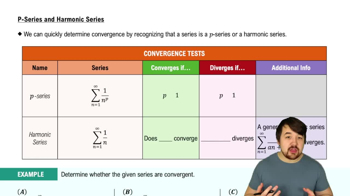
Harmonic Series

The harmonic series is the sum of reciprocals of natural numbers: 1 + 1/2 + 1/3 + ... + 1/n. It grows without bound as n increases, but very slowly. Understanding its divergence is key to analyzing its behavior compared to integrals and logarithmic functions.
Recommended video:
04:30
P-Series and Harmonic Series

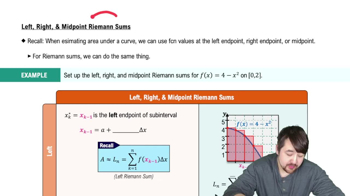
Left Riemann Sum Approximation

A left Riemann sum approximates the integral of a function by summing the areas of rectangles using the function's value at the left endpoint of each subinterval. For f(x) = 1/x on [1, n+1] with unit spacing, this sum corresponds to the harmonic sum, linking discrete sums to continuous integrals.
Recommended video:
07:39
Left, Right, & Midpoint Riemann Sums

Improper Integral and Limit Comparison

The integral ∫[1 to n+1] (1/x) dx equals ln(n+1), which grows without bound as n → ∞. Comparing the harmonic sum to this integral shows the sum exceeds ln(n+1), proving the harmonic series diverges and its limit does not exist (it tends to infinity).
Recommended video:
11:11
Improper Integrals: Infinite Intervals