
Does a right Riemann sum underestimate or overestimate the area of the region under the graph of a function that is positive and decreasing on an interval [a,b]? Explain.
Table of contents
- 0. Functions7h 54m
- Introduction to Functions16m
- Piecewise Functions10m
- Properties of Functions9m
- Common Functions1h 8m
- Transformations5m
- Combining Functions27m
- Exponent rules32m
- Exponential Functions28m
- Logarithmic Functions24m
- Properties of Logarithms36m
- Exponential & Logarithmic Equations35m
- Introduction to Trigonometric Functions38m
- Graphs of Trigonometric Functions44m
- Trigonometric Identities47m
- Inverse Trigonometric Functions48m
- 1. Limits and Continuity2h 2m
- 2. Intro to Derivatives1h 33m
- 3. Techniques of Differentiation3h 18m
- 4. Applications of Derivatives2h 38m
- 5. Graphical Applications of Derivatives6h 2m
- 6. Derivatives of Inverse, Exponential, & Logarithmic Functions2h 37m
- 7. Antiderivatives & Indefinite Integrals1h 26m
- 8. Definite Integrals4h 44m
- 9. Graphical Applications of Integrals2h 27m
- 10. Physics Applications of Integrals 3h 16m
- 11. Integrals of Inverse, Exponential, & Logarithmic Functions2h 34m
- 12. Techniques of Integration7h 41m
- 13. Intro to Differential Equations2h 55m
- 14. Sequences & Series5h 36m
- 15. Power Series2h 19m
- 16. Parametric Equations & Polar Coordinates7h 58m
8. Definite Integrals
Riemann Sums
Problem 5.1.17
Textbook Question
Approximating displacement The velocity of an object is given by the following functions on a specified interval. Approximate the displacement of the object on this interval by subdividing the interval into n subintervals. Use the left endpoint of each subinterval to compute the height of the rectangles.
v = 2t + 1(m/s), for 0 ≤ t ≤ 8 ; n = 2
Verified step by step guidance1
Step 1: Understand the problem. The goal is to approximate the displacement of the object over the interval [0, 8] using the velocity function v = 2t + 1. The interval is subdivided into n = 2 subintervals, and the left endpoint of each subinterval is used to compute the height of the rectangles.
Step 2: Divide the interval [0, 8] into n = 2 subintervals. The width of each subinterval (Δt) is calculated as Δt = (8 - 0) / 2 = 4. So the subintervals are [0, 4] and [4, 8].
Step 3: Determine the left endpoints of each subinterval. For the subinterval [0, 4], the left endpoint is t = 0. For the subinterval [4, 8], the left endpoint is t = 4.
Step 4: Evaluate the velocity function v = 2t + 1 at each left endpoint. For t = 0, v(0) = 2(0) + 1 = 1. For t = 4, v(4) = 2(4) + 1 = 9.
Step 5: Approximate the displacement by summing the areas of the rectangles. The area of each rectangle is given by height × width. For the first rectangle, the area is v(0) × Δt = 1 × 4. For the second rectangle, the area is v(4) × Δt = 9 × 4. Add these areas together to approximate the total displacement.
Verified video answer for a similar problem:This video solution was recommended by our tutors as helpful for the problem above
Video duration:
3mPlay a video:
Was this helpful?
Key Concepts
Here are the essential concepts you must grasp in order to answer the question correctly.
Velocity and Displacement
Velocity is the rate of change of displacement with respect to time. In this context, the velocity function v(t) = 2t + 1 describes how the object's speed changes over time. Displacement can be approximated by integrating the velocity function over a specified interval, which gives the total change in position of the object.
Recommended video:
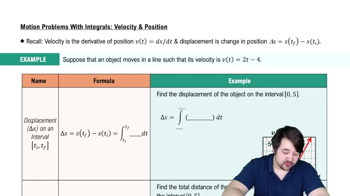
Using The Velocity Function
Riemann Sums
Riemann sums are a method for approximating the integral of a function, which in this case represents the displacement. By dividing the interval into n subintervals and using the left endpoint of each subinterval to determine the height of rectangles, we can estimate the area under the velocity curve. This area corresponds to the total displacement over the interval.
Recommended video:
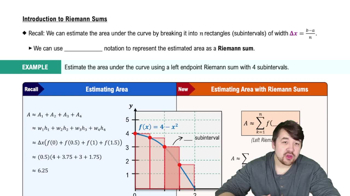
Introduction to Riemann Sums
Subintervals and Left Endpoint Approximation
Subdividing the interval into n subintervals allows for a more manageable calculation of the area under the curve. The left endpoint approximation specifically uses the value of the function at the left end of each subinterval to calculate the height of the rectangles. This method provides a way to estimate the integral, which is particularly useful when the exact integral is difficult to compute.
Recommended video:
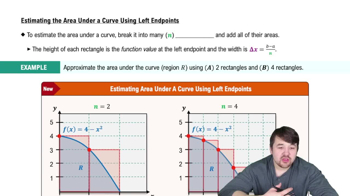
Estimating the Area Under a Curve Using Left Endpoints
Related Videos
Related Practice
Textbook Question
34
views
