7–58. Improper integrals Evaluate the following integrals or state that they diverge. 47. ∫ (from 0 to 10) 1/∜(10 - x) dx
Verified step by step guidance
1
Identify the integral and the function to be integrated: \( \int_0^{10} \frac{1}{\sqrt[4]{10 - x}} \, dx \). Notice that the integrand involves a fourth root in the denominator, which can cause issues near \( x = 10 \).
Check for any points of discontinuity or where the integrand might be undefined within the interval \([0, 10]\). Since \( \sqrt[4]{10 - x} \) becomes zero at \( x = 10 \), the integrand tends to infinity there, indicating an improper integral at the upper limit.
Rewrite the integral as a limit to handle the improper behavior at \( x = 10 \): \[ \lim_{t \to 10^-} \int_0^t \frac{1}{(10 - x)^{1/4}} \, dx \]. This allows us to evaluate the integral up to a point \( t < 10 \) and then take the limit as \( t \) approaches 10 from the left.
Perform a substitution to simplify the integral. Let \( u = 10 - x \), which implies \( du = -dx \). Change the limits accordingly: when \( x = 0 \), \( u = 10 \); when \( x = t \), \( u = 10 - t \). The integral becomes \( \int_{u=10}^{u=10 - t} u^{-1/4} (-du) = \int_{10 - t}^{10} u^{-1/4} \, du \).
Integrate \( u^{-1/4} \) with respect to \( u \) using the power rule for integrals: \( \int u^n \, du = \frac{u^{n+1}}{n+1} + C \), where \( n = -\frac{1}{4} \). After integrating, substitute back the limits \( u = 10 - t \) and \( u = 10 \), then take the limit as \( t \to 10^- \) to determine if the integral converges or diverges.
Verified video answer for a similar problem:
This video solution was recommended by our tutors as helpful for the problem above
Video duration:
5m
Play a video:
0 Comments
Key Concepts
Here are the essential concepts you must grasp in order to answer the question correctly.
Improper Integrals
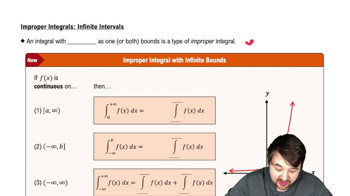
Improper integrals involve integrals with infinite limits or integrands that become unbounded within the interval. To evaluate them, we often take limits approaching the problematic point to determine if the integral converges or diverges.
Understanding how the function behaves near points where it may become infinite or undefined is crucial. For the integral ∫₀¹⁰ 1/∜(10 - x) dx, the integrand becomes unbounded as x approaches 10, requiring careful limit evaluation.
When an integral has a discontinuity at an endpoint, we replace the problematic limit with a variable and take the limit as it approaches that point. This process helps determine if the integral converges to a finite value or diverges.