45–63. Absolute and conditional convergence Determine whether the following series converge absolutely, converge conditionally, or diverge. ∑ (k = 2 to ∞) (−1)ᵏ · k · (k² + 1) / (k³ − 1)
Verified step by step guidance
1
Identify the given series: \( \sum_{k=2}^{\infty} (-1)^k \cdot k \cdot \frac{k^2 + 1}{k^3 - 1} \). Notice it is an alternating series because of the factor \( (-1)^k \).
To check for absolute convergence, consider the absolute value of the terms: \( \left| (-1)^k \cdot k \cdot \frac{k^2 + 1}{k^3 - 1} \right| = k \cdot \frac{k^2 + 1}{k^3 - 1} \). Simplify this expression to understand its behavior as \( k \to \infty \).
Analyze the limit of the absolute value terms as \( k \to \infty \). Since the highest powers dominate, approximate \( k \cdot \frac{k^2 + 1}{k^3 - 1} \approx k \cdot \frac{k^2}{k^3} = 1 \). This suggests the terms do not approach zero, which is crucial for convergence.
Since the terms of the absolute value do not tend to zero, the series does not converge absolutely. Next, check for conditional convergence by applying the Alternating Series Test (Leibniz Test). For this, verify if the sequence \( a_k = k \cdot \frac{k^2 + 1}{k^3 - 1} \) is decreasing and tends to zero.
Determine whether \( a_k \) is decreasing and if \( \lim_{k \to \infty} a_k = 0 \). If either condition fails, the series diverges; if both hold, the series converges conditionally.
Verified video answer for a similar problem:
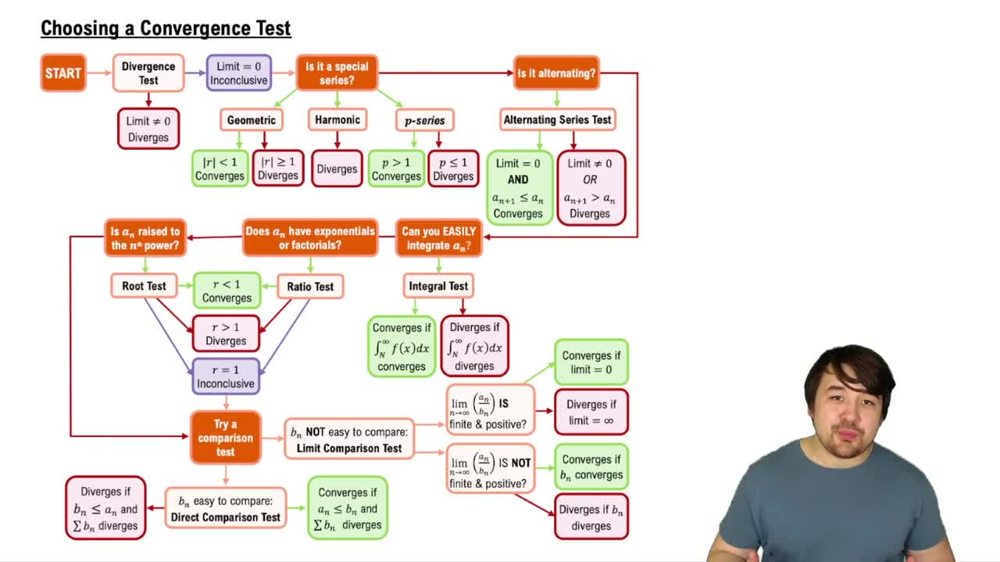
This video solution was recommended by our tutors as helpful for the problem above
Video duration:
3m
Play a video:
0 Comments
Key Concepts
Here are the essential concepts you must grasp in order to answer the question correctly.
Absolute Convergence
A series ∑a_k converges absolutely if the series of absolute values ∑|a_k| converges. Absolute convergence implies convergence regardless of the sign of terms, and it guarantees the sum is well-defined and stable under rearrangement.
A series converges conditionally if it converges, but does not converge absolutely. This means ∑a_k converges, but ∑|a_k| diverges. Conditional convergence often occurs in alternating series where the terms decrease in magnitude.
To determine convergence, tests like the Alternating Series Test, Comparison Test, or Limit Comparison Test are used. For the given series, analyzing the behavior of terms and applying these tests helps decide if the series converges absolutely, conditionally, or diverges.