Ch. 10 - Sequences and Infinite Series
Briggs - Calculus: Early Transcendentals 3rd Edition
Briggs3rd EditionCalculus: Early TranscendentalsISBN: 9780136847243Not the one you use?Change textbook
Chapter 10, Problem 10.6.63

45–63. Absolute and conditional convergence Determine whether the following series converge absolutely, converge conditionally, or diverge.
∑ (k = 1 to ∞) (−1)ᵏ⁺¹ · (k!) / (kᵏ)(Hint: Show that k! / kᵏ ≤ 2 / k², for k ≥ 3.)

Verified step by step guidance
1
First, identify the general term of the series: \[a_k = (-1)^{k+1} \cdot \frac{k!}{k^k}\]. Since the series is alternating due to the factor \[(-1)^{k+1}\], we consider both absolute and conditional convergence.
To check for absolute convergence, examine the absolute value of the terms: \[|a_k| = \frac{k!}{k^k}\]. We want to determine if the series \[\sum_{k=1}^\infty \frac{k!}{k^k}\] converges.
Use the given hint to compare \[\frac{k!}{k^k}\] with \[\frac{2}{k^2}\] for \[k \geq 3\]. Since \[\frac{k!}{k^k} \leq \frac{2}{k^2}\], and the series \[\sum \frac{2}{k^2}\] converges (p-series with \[p=2 > 1\]), by the Comparison Test, the series of absolute values converges.
Since the series of absolute values converges, the original alternating series converges absolutely. Absolute convergence implies convergence regardless of the alternating sign.
Therefore, conclude that the series \[\sum_{k=1}^\infty (-1)^{k+1} \frac{k!}{k^k}\] converges absolutely.

Verified video answer for a similar problem:

This video solution was recommended by our tutors as helpful for the problem above.
Video duration:
4m
Was this helpful?

Key Concepts

Here are the essential concepts you must grasp in order to answer the question correctly.

Absolute and Conditional Convergence

A series converges absolutely if the series of absolute values converges. If the original series converges but not absolutely, it is conditionally convergent. Understanding this distinction helps determine the nature of convergence for alternating or complex series.
Recommended video:
07:51
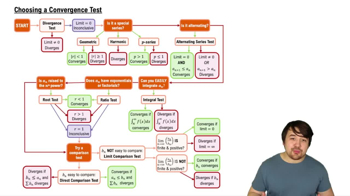
Choosing a Convergence Test

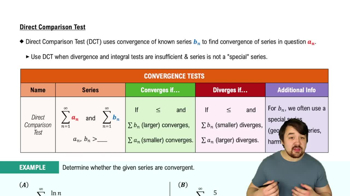
Comparison Test

The comparison test involves comparing a given series to a known benchmark series to determine convergence. If the terms of the given series are smaller than those of a convergent series, it also converges. This test is useful when bounding terms like k!/k^k by simpler expressions.
Recommended video:
09:25
Direct Comparison Test

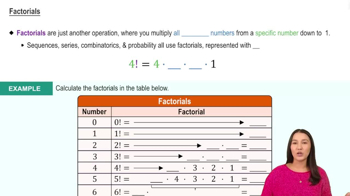
Factorials and Exponential Growth

Factorials (k!) grow faster than polynomial terms but slower than some exponentials. The term k!/k^k involves factorial growth divided by exponential growth, and analyzing their relative rates is key to estimating term size and applying convergence tests effectively.
Recommended video:
5:22
Factorials