
Ch.12 - Parametric and Polar Curves
Briggs - Calculus: Early Transcendentals 3rd Edition
Briggs3rd EditionCalculus: Early TranscendentalsISBN: 9780136847243Not the one you use?Change textbook
Chapter 12, Problem 12.4.76

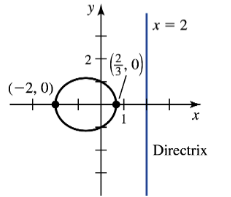
75–76. Graphs to polar equations Find a polar equation for each conic section. Assume one focus is at the origin.
img

Verified step by step guidance
1
Identify the key elements from the graph: the focus is at the origin (0,0), the directrix is the vertical line \(x=2\), and the conic appears to be an ellipse.
Recall the general polar form of a conic section with one focus at the origin: \(r = \frac{ed}{1 + e \cos \theta}\), where \(e\) is the eccentricity and \(d\) is the distance from the focus to the directrix.
From the graph, determine the distance \(d\) from the origin (focus) to the directrix line \(x=2\). Since the directrix is vertical at \(x=2\), \(d=2\).
Find the eccentricity \(e\) by using the information about the ellipse. For an ellipse, \(e < 1\). Use the given points or the shape to estimate or calculate \(e\) if possible, or use the relationship between the ellipse's dimensions and \(e\).
Substitute the values of \(e\) and \(d\) into the polar equation \(r = \frac{ed}{1 + e \cos \theta}\) to write the polar equation of the conic section.

Verified video answer for a similar problem:

This video solution was recommended by our tutors as helpful for the problem above.
Video duration:
3m
Was this helpful?

Key Concepts

Here are the essential concepts you must grasp in order to answer the question correctly.

Polar Equations of Conic Sections

Polar equations represent conic sections using a focus at the origin and a directrix line. The general form is r = ed / (1 ± e cos θ) or r = ed / (1 ± e sin θ), where e is the eccentricity and d is the distance from the focus to the directrix. This form helps describe ellipses, parabolas, and hyperbolas in polar coordinates.
Recommended video:
5:33
Parabolas as Conic Sections

Eccentricity and Its Role

Eccentricity (e) measures how much a conic deviates from being circular. For ellipses, 0 < e < 1; for parabolas, e = 1; and for hyperbolas, e > 1. It determines the shape and size of the conic and is essential in forming the polar equation relative to the focus and directrix.
Recommended video:
07:39
Classifying Differential Equations

Directrix and Focus Relationship

A conic section is defined as the set of points where the ratio of the distance to the focus and the distance to the directrix is constant (eccentricity). The directrix is a fixed line, and the focus is a fixed point; their positions determine the conic's orientation and equation in polar form.
Recommended video:
5:33
Parabolas as Conic Sections