c. Determine the interval of convergence of the series.
f(x) = e⁻ˣ, a=0
Verified step by step guidance
1
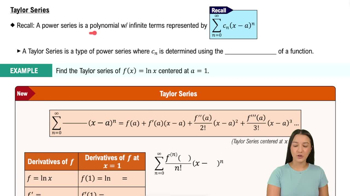
Recall that the Taylor series for the function \(f(x) = e^{-x}\) centered at \(a=0\) is given by the Maclaurin series expansion:
\[f(x) = \sum_{n=0}^{\infty} \frac{f^{(n)}(0)}{n!} x^n\]
Since \(f(x) = e^{-x}\), all derivatives are of the form \(f^{(n)}(x) = (-1)^n e^{-x}\), so at \(x=0\), \(f^{(n)}(0) = (-1)^n\).
Write the Taylor series explicitly using the derivatives at 0:
\[e^{-x} = \sum_{n=0}^{\infty} \frac{(-1)^n}{n!} x^n = \sum_{n=0}^{\infty} \frac{(-x)^n}{n!}\]
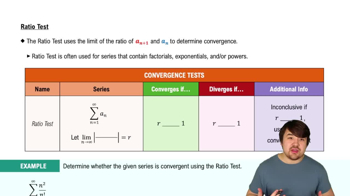
To find the interval of convergence, apply the Ratio Test to the general term of the series:
Let \(a_n = \frac{(-x)^n}{n!}\). Then consider
\[L = \lim_{n \to \infty} \left| \frac{a_{n+1}}{a_n} \right| = \lim_{n \to \infty} \left| \frac{(-x)^{n+1} / (n+1)!}{(-x)^n / n!} \right| = \lim_{n \to \infty} \frac{|x|}{n+1}\]
Evaluate the limit \(L\):
Since \(\lim_{n \to \infty} \frac{|x|}{n+1} = 0\) for all real \(x\), the Ratio Test tells us the series converges for all \(x \in \mathbb{R}\).
Conclude that the interval of convergence is the entire real line:
\[(-\infty, \infty)\]
This means the Taylor series for \(e^{-x}\) converges for every real number \(x\).
Verified video answer for a similar problem:
This video solution was recommended by our tutors as helpful for the problem above
Video duration:
5m
Play a video:
Was this helpful?
Key Concepts
Here are the essential concepts you must grasp in order to answer the question correctly.
Taylor Series Expansion
A Taylor series represents a function as an infinite sum of terms calculated from the derivatives of the function at a single point. For f(x) = e^{-x} at a = 0, the series is formed using derivatives evaluated at 0, allowing approximation of the function near that point.
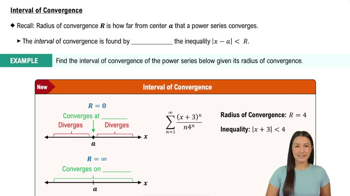
The interval of convergence is the set of x-values for which the Taylor series converges to the function. Determining this interval involves testing the series for convergence using methods like the ratio or root test, ensuring the series accurately represents the function within that range.
The ratio test is a method to determine the convergence of an infinite series by examining the limit of the ratio of successive terms. If this limit is less than one, the series converges absolutely; if greater than one, it diverges. This test is commonly used to find the radius and interval of convergence for power series.