9–40. Integration by parts Evaluate the following integrals using integration by parts. 26. ∫ t³ sin(t) dt
Verified step by step guidance
1
Identify the integral to solve: \(\int t^{3} \sin(t) \, dt\).
Choose parts for integration by parts: let \(u = t^{3}\) (which simplifies when differentiated) and \(dv = \sin(t) \, dt\) (which is easy to integrate).
Compute the derivatives and integrals needed: find \(du = 3t^{2} \, dt\) and \(v = -\cos(t)\) (since the integral of \(\sin(t)\) is \(-\cos(t)\)).
Apply the integration by parts formula: \(\int u \, dv = uv - \int v \, du\), so write \(\int t^{3} \sin(t) \, dt = -t^{3} \cos(t) - \int (-\cos(t)) (3t^{2}) \, dt\).
Simplify the integral and prepare to repeat integration by parts on \(\int 3t^{2} \cos(t) \, dt\) to fully evaluate the original integral.
Verified video answer for a similar problem:
This video solution was recommended by our tutors as helpful for the problem above
Video duration:
11m
Play a video:
0 Comments
Key Concepts
Here are the essential concepts you must grasp in order to answer the question correctly.
Integration by Parts Formula
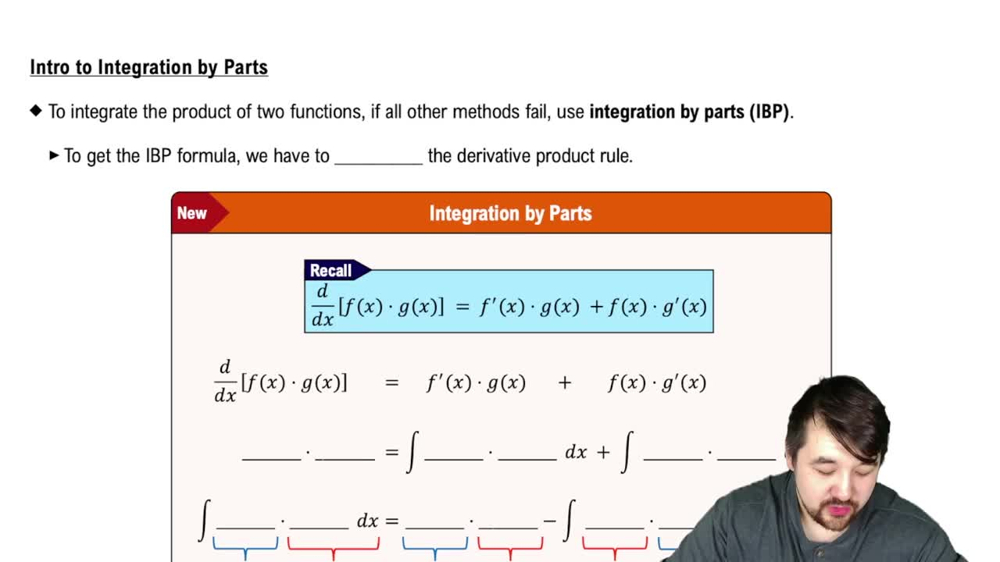
Integration by parts is a technique derived from the product rule of differentiation. It states that ∫u dv = uv - ∫v du, where u and dv are parts of the integrand chosen to simplify the integral. Selecting u and dv wisely is crucial for solving complex integrals.
When applying integration by parts, u is typically chosen as a function that simplifies upon differentiation, while dv is chosen as a function that is easy to integrate. For example, in ∫t³ sin(t) dt, choosing u = t³ and dv = sin(t) dt helps reduce the power of t through differentiation.
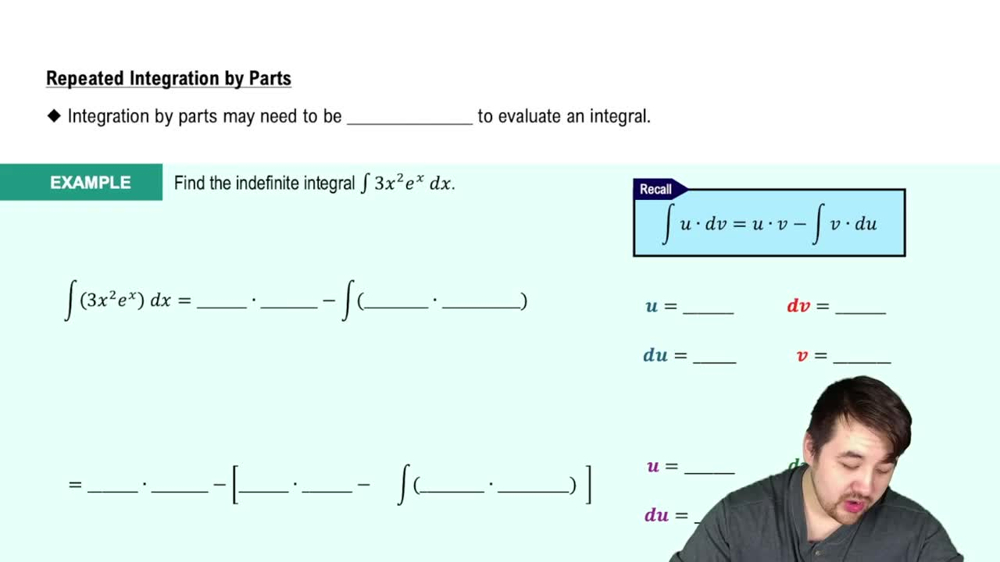
Some integrals, like ∫t³ sin(t) dt, require applying integration by parts multiple times to fully evaluate. Each application reduces the power of t until the integral becomes straightforward. Keeping track of each step carefully ensures correct and complete solutions.

 11:11 minutes
 Verified step by step guidance
 08:30
08:30