9–40. Integration by parts Evaluate the following integrals using integration by parts. 32. ∫ from 0 to 1 x² 2ˣ dx
Verified step by step guidance
1
Identify the integral to solve: \(\int_0^1 x^2 2^x \, dx\).
Choose functions for integration by parts. Let \(u = x^2\) (which simplifies when differentiated) and \(dv = 2^x \, dx\) (which can be integrated).
Compute \(du\) and \(v\): differentiate \(u\) to get \(du = 2x \, dx\), and integrate \(dv\) to find \(v\). Recall that \(\int a^x \, dx = \frac{a^x}{\ln a} + C\), so here \(v = \frac{2^x}{\ln 2}\).
Apply the integration by parts formula: \(\int u \, dv = uv - \int v \, du\). Substitute the expressions for \(u\), \(v\), \(du\) to write the integral in terms of a simpler integral.
Evaluate the resulting integral and apply the limits from 0 to 1. If the new integral still requires integration by parts, repeat the process until the integral is fully evaluated.
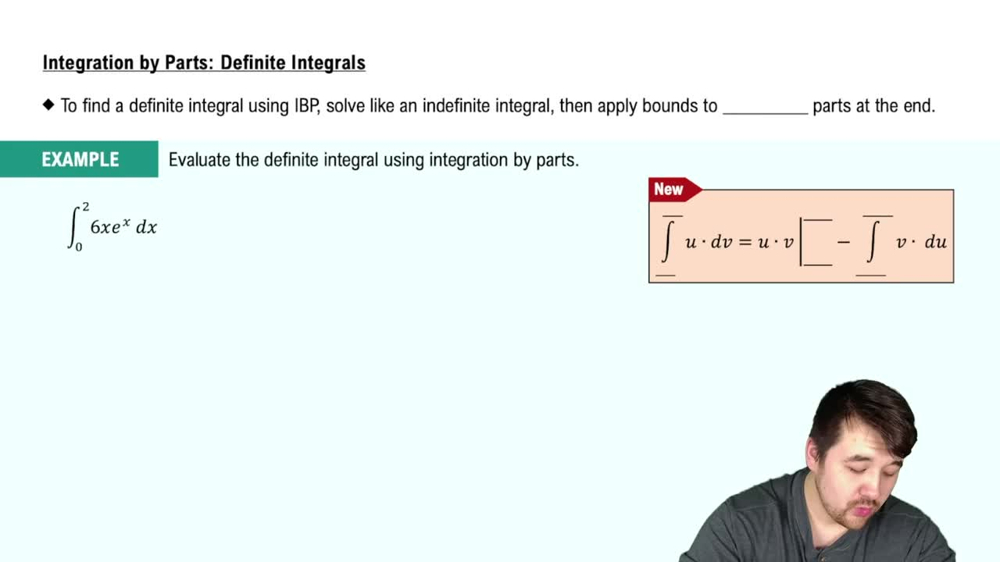
Verified video answer for a similar problem:
This video solution was recommended by our tutors as helpful for the problem above
Video duration:
6m
Play a video:
0 Comments
Key Concepts
Here are the essential concepts you must grasp in order to answer the question correctly.
Integration by Parts
Integration by parts is a technique derived from the product rule of differentiation. It transforms the integral of a product of functions into simpler integrals using the formula ∫u dv = uv - ∫v du. Choosing u and dv wisely simplifies the integral evaluation.
Exponential functions like 2^x grow or decay at rates proportional to their value. When integrating, it’s important to recognize that the derivative and integral of 2^x involve the natural logarithm of the base, since d/dx(2^x) = 2^x ln(2).
Definite integrals compute the net area under a curve between two limits. After finding the antiderivative, evaluate it at the upper and lower bounds and subtract to find the integral’s value over the interval [0,1].

 6:06 minutes
 Verified step by step guidance
 06:18
06:18