
Textbook Question
11-14. {Use of Tech} Compute the absolute and relative errors in using c to approximate x.
12. x = √2; c = 1.414
86
views

 Verified step by step guidance
 5:50
5:50 5:50
5:50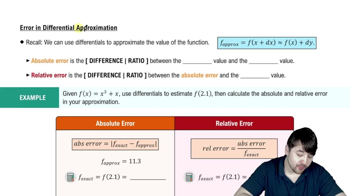 04:57
04:5711-14. {Use of Tech} Compute the absolute and relative errors in using c to approximate x.
12. x = √2; c = 1.414
"Electric field due to a line of charge A total charge of Q is distributed uniformly on a line segment of length 2L along the y-axis (see figure). The x-component of the electric field at a point (a, 0) is given by
Eₓ(a) = (kQa/2L) ∫-L L dy/(a² + y²)^(3/2),
where k is a physical constant and a > 0.
a. Confirm that Eₓ(a)=kQ / a √(a²+L²)
b. Letting ρ=Q / 2 L be the charge density on the line segment, show that if L → ∞, then Eₓ(a) = 2kρ / a.
Let f(x) = √(x + 1). Find the area of the surface generated when:
Region bounded by f(x) and the x-axis on [0, 1]
Revolved about the x-axis
60–69. Completing the square Evaluate the following integrals.
62. ∫ du / (2u² - 12u + 36)
5-8. Compute the following estimates of ∫(0 to 8) f(x) dx using the graph in the figure.
6. T(4)
2–74. Integration techniques Use the methods introduced in Sections 8.1 through 8.5 to evaluate the following integrals.
10. ∫ (x³ + 3x² + 1)/(x³ + 1) dx