27. {Use of Tech} Midpoint Rule, Trapezoid Rule, and relative error Find the Midpoint and Trapezoid Rule approximations to ∫(0 to 1) sin(πx) dx using n = 25 subintervals. Compute the relative error of each approximation.
Verified step by step guidance
1
Step 1: Understand the problem. You are tasked with approximating the integral ∫(0 to 1) sin(πx) dx using two numerical methods: the Midpoint Rule and the Trapezoid Rule, with n = 25 subintervals. Additionally, you need to compute the relative error for each approximation.
Step 2: Divide the interval [0, 1] into n = 25 subintervals. The width of each subinterval, denoted as Δx, is calculated as Δx = (b - a) / n, where a = 0 and b = 1. Thus, Δx = 1 / 25.
Step 3: Apply the Midpoint Rule. For the Midpoint Rule, the approximation is given by: M = Δx * Σ(f(xᵢ)), where xᵢ is the midpoint of each subinterval. The midpoints are calculated as xᵢ = a + (i - 0.5)Δx for i = 1, 2, ..., n. Evaluate f(xᵢ) = sin(πxᵢ) at each midpoint and sum the results.
Step 4: Apply the Trapezoid Rule. For the Trapezoid Rule, the approximation is given by: T = (Δx / 2) * [f(a) + 2Σ(f(xᵢ)) + f(b)], where xᵢ are the endpoints of the subintervals. Evaluate f(xᵢ) = sin(πxᵢ) at each endpoint and sum the results.
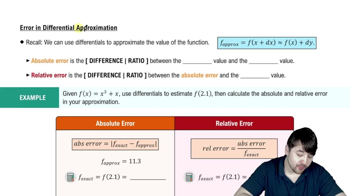
Step 5: Compute the relative error for each approximation. The relative error is calculated as: Relative Error = |(Exact Value - Approximation) / Exact Value|. The exact value of the integral ∫(0 to 1) sin(πx) dx can be computed analytically as -cos(πx) evaluated from 0 to 1, which simplifies to 2/π. Use this exact value to compute the relative error for both the Midpoint and Trapezoid Rule approximations.
Verified video answer for a similar problem:
This video solution was recommended by our tutors as helpful for the problem above
Video duration:
11m
Play a video:
Was this helpful?
Key Concepts
Here are the essential concepts you must grasp in order to answer the question correctly.
Midpoint Rule
The Midpoint Rule is a numerical integration technique that approximates the area under a curve by dividing it into subintervals and using the midpoint of each subinterval to calculate the height of rectangles. For each subinterval, the function value at the midpoint is multiplied by the width of the subinterval, and the sum of these areas gives the total approximation of the integral.
The Trapezoid Rule is another numerical method for estimating the value of a definite integral. It approximates the area under a curve by dividing the interval into subintervals and forming trapezoids rather than rectangles. The area of each trapezoid is calculated using the average of the function values at the endpoints of each subinterval, multiplied by the width of the subinterval, and the total area is the sum of these trapezoidal areas.
Relative error is a measure of the accuracy of an approximation compared to the exact value. It is calculated by taking the absolute difference between the exact value and the approximation, dividing it by the exact value, and often expressing it as a percentage. This metric helps to assess how close the numerical approximation is to the true value of the integral, providing insight into the effectiveness of the numerical methods used.