
Ch. 10 - Sequences and Infinite Series
Briggs - Calculus: Early Transcendentals 3rd Edition
Briggs3rd EditionCalculus: Early TranscendentalsISBN: 9780136847243Not the one you use?Change textbook
Chapter 10, Problem 10.1.33a

27–34. Working with sequences Several terms of a sequence {aₙ}ₙ₌₁∞ are given.
a. Find the next two terms of the sequence.
{-5, 5, -5, 5, ......}

Verified step by step guidance
1
Observe the given sequence: \(\{-5, 5, -5, 5, \ldots\}\). Notice the pattern of signs and values alternating between \(-5\) and \(5\).
Identify the rule governing the sequence. Since the terms alternate between \(-5\) and \(5\), the sequence can be described as \(a_n = (-1)^n \times 5\) or \(a_n = (-1)^{n+1} \times 5\), depending on the starting index.
To find the next two terms, determine the position of the last given term. The last term provided is the 4th term, which is \(5\).
Calculate the 5th term by applying the pattern: since the 4th term is \(5\), the 5th term will be \(-5\) (continuing the alternating sign pattern).
Similarly, calculate the 6th term, which will be \(5\), following the established alternating pattern.

Verified video answer for a similar problem:

This video solution was recommended by our tutors as helpful for the problem above.
Video duration:
1m
Was this helpful?

Key Concepts

Here are the essential concepts you must grasp in order to answer the question correctly.

Sequences and Terms

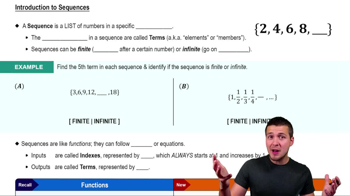
A sequence is an ordered list of numbers defined by a specific rule. Each number in the sequence is called a term, denoted as aₙ, where n indicates its position. Understanding how terms relate to each other helps predict future terms.
Recommended video:
Guided course
8:22
Introduction to Sequences

Pattern Recognition in Sequences

Identifying the pattern or rule governing the sequence is essential. This involves observing how terms change from one to the next, such as alternating signs or repeating values, to determine the next terms accurately.
Recommended video:
Guided course
8:22
Introduction to Sequences

Alternating Sequences

An alternating sequence is one where the signs of the terms switch between positive and negative in a regular pattern. Recognizing this helps in predicting subsequent terms by applying the sign change rule consistently.
Recommended video:
Guided course
8:22
Introduction to Sequences
Related Practice
Textbook Question

88–89. Binary numbers

Humans use the ten digits 0 through 9 to form base-10 or decimal numbers, whereas computers calculate and store numbers internally as binary numbers—numbers consisting entirely of 0’s and 1’s. For this exercise, we consider binary numbers that have the form 0.b₁b₂b₃⋯, where each of the digits b₁, b₂, b₃, ⋯ is either 0 or 1. The base-10 representation of the binary number 0.b₁b₂b₃⋯ is the infinite series

b₁ / 2¹ + b₂ / 2² + b₃ / 2³ + ⋯


89. Computers can store only a finite number of digits and therefore numbers with nonterminating digits must be rounded or truncated before they can be used and stored by a computer.


a. Find the base-10 representation of the binary number 0.001̅1.

70
views
Textbook Question

Explain why or why not Determine whether the following statements are true and give an explanation or counterexample.


a. The sum ∑ (k = 1 to ∞) 1 / 3ᵏ is a p-series.

56
views
Textbook Question

27–34. Working with sequences Several terms of a sequence {aₙ}ₙ₌₁∞ are given.

a. Find the next two terms of the sequence.

{1, 2, 4, 8, 16, ......}

54
views
Textbook Question

41–44. {Use of Tech} Remainders and estimates Consider the following convergent series.


a. Find an upper bound for the remainder in terms of n.


41. ∑ (k = 1 to ∞) 1 / k⁶

105
views
Textbook Question

Loglog p-series Consider the series ∑ (k = 2 to ∞) 1 / (k(ln k)(ln ln k)ᵖ), where p is a real number.

a. For what values of p does this series converge?

52
views
Textbook Question

{Use of Tech} Repeated square roots

Consider the sequence defined by

aₙ₊₁ = √(2 + aₙ),a₀ = √2, for n = 0, 1, 2, 3, …


a.Evaluate the first four terms of the sequence {aₙ}.

State the exact values first, and then the approximate values.

38
views