46–50. Force on dams The following figures show the shapes and dimensions of small dams. Assuming the water level is at the top of the dam, find the total force on the face of the dam.
Table of contents
- 0. Functions7h 54m
- Introduction to Functions16m
- Piecewise Functions10m
- Properties of Functions9m
- Common Functions1h 8m
- Transformations5m
- Combining Functions27m
- Exponent rules32m
- Exponential Functions28m
- Logarithmic Functions24m
- Properties of Logarithms36m
- Exponential & Logarithmic Equations35m
- Introduction to Trigonometric Functions38m
- Graphs of Trigonometric Functions44m
- Trigonometric Identities47m
- Inverse Trigonometric Functions48m
- 1. Limits and Continuity2h 2m
- 2. Intro to Derivatives1h 33m
- 3. Techniques of Differentiation3h 18m
- 4. Applications of Derivatives2h 38m
- 5. Graphical Applications of Derivatives6h 2m
- 6. Derivatives of Inverse, Exponential, & Logarithmic Functions2h 37m
- 7. Antiderivatives & Indefinite Integrals1h 26m
- 8. Definite Integrals4h 44m
- 9. Graphical Applications of Integrals2h 27m
- 10. Physics Applications of Integrals 3h 16m
- 11. Integrals of Inverse, Exponential, & Logarithmic Functions2h 34m
- 12. Techniques of Integration7h 41m
- 13. Intro to Differential Equations2h 55m
- 14. Sequences & Series5h 36m
- 15. Power Series2h 19m
- 16. Parametric Equations & Polar Coordinates7h 58m
10. Physics Applications of Integrals
Work
Problem 6.7.66
Textbook Question
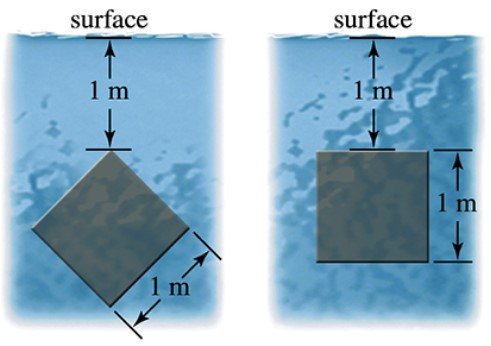
Orientation and force A plate shaped like an equilateral triangle 1 m on a side is placed on a vertical wall 1 m below the surface of a pool filled with water. On which plate in the figure is the force greater? Try to anticipate the answer and then compute the force on each plate.

Verified step by step guidance1
Step 1: Understand the problem context. We have two plates submerged 1 meter below the water surface. One plate is diamond-shaped (a square rotated 45 degrees) and the other is a square, both with side lengths of 1 meter. We need to determine which plate experiences a greater force due to water pressure and then calculate the force on each plate.
Step 2: Recall the formula for hydrostatic force on a submerged vertical surface: \(F = \rho g A \bar{h}\), where \(\rho\) is the density of water, \(g\) is acceleration due to gravity, \(A\) is the area of the plate, and \(\bar{h}\) is the depth of the centroid of the plate below the water surface.
Step 3: Calculate the area \(A\) of each plate. For the square plate, \(A = 1 \times 1 = 1\) m\(^2\). For the diamond-shaped plate, since it is a square rotated by 45 degrees with side length 1 m, its area is also \$1\( m\)^2$ (area of a square is side squared, rotation does not change area).
Step 4: Determine the depth of the centroid \(\bar{h}\) for each plate. For the square plate, the centroid is at the midpoint, so \(\bar{h} = 1 + \frac{1}{2} = 1.5\) m below the surface. For the diamond-shaped plate, the vertical height of the diamond is \(\sqrt{2}\) times the side length, so the centroid is at half this height below the surface plus the 1 m depth to the top vertex. Calculate \(\bar{h}\) accordingly.
Step 5: Use the hydrostatic force formula to compute the force on each plate by substituting \(\rho\), \(g\), \(A\), and \(\bar{h}\) for each plate. Compare the forces to determine which plate experiences the greater force.
Verified video answer for a similar problem:This video solution was recommended by our tutors as helpful for the problem above
Video duration:
3mPlay a video:
Was this helpful?
Key Concepts
Here are the essential concepts you must grasp in order to answer the question correctly.
Hydrostatic Pressure
Hydrostatic pressure is the pressure exerted by a fluid at rest due to the force of gravity. It increases linearly with depth and is given by the formula P = ρgh, where ρ is the fluid density, g is gravitational acceleration, and h is the depth below the surface.
Force on a Submerged Surface
The force exerted by a fluid on a submerged surface is the product of the pressure and the area of the surface. Since pressure varies with depth, the total force is found by integrating the pressure over the surface area, often simplified by using the average pressure at the centroid depth.
Recommended video:
Example 1: Minimizing Surface Area
Centroid and Orientation of Submerged Plates
The centroid of a submerged plate determines the average depth at which pressure acts. The orientation affects the shape and position of the plate relative to the fluid surface, influencing the centroid depth and thus the hydrostatic force on the plate.
Recommended video:
Cardioids Example 1
Watch next
Master Introduction To Work with a bite sized video explanation from Patrick
Start learningRelated Videos
Related Practice
Textbook Question
12
views