Tangent line at the origin Find the polar equation of the line tangent to the polar curve r=4cosθ at the origin. Explain why the slope of this line is undefined.
Ch.12 - Parametric and Polar Curves
Briggs3rd EditionCalculus: Early TranscendentalsISBN: 9780136847243Not the one you use?Change textbook
Chapter 12, Problem 12.1.25
15–30. Working with parametric equations Consider the following parametric equations.
a. Eliminate the parameter to obtain an equation in x and y.
b. Describe the curve and indicate the positive orientation.
x = r − 1, y = r³; −4 ≤ r ≤ 4
Verified step by step guidance1
Identify the given parametric equations: \(x = r - 1\) and \(y = r^{3}\), with the parameter \(r\) ranging from \(-4\) to \(4\).
To eliminate the parameter \(r\), solve the first equation for \(r\): \(r = x + 1\).
Substitute \(r = x + 1\) into the second equation to express \(y\) solely in terms of \(x\): \(y = (x + 1)^{3}\).
Recognize that the resulting equation \(y = (x + 1)^{3}\) represents a cubic curve, which is a shifted cubic function along the x-axis.
For the positive orientation, note that as \(r\) increases from \(-4\) to \(4\), \(x\) increases from \(-5\) to \(3\), and \(y\) follows the cubic relationship accordingly, indicating the direction of the curve from left to right.

Verified video answer for a similar problem:
This video solution was recommended by our tutors as helpful for the problem above.
Video duration:
3mWas this helpful?
Key Concepts
Here are the essential concepts you must grasp in order to answer the question correctly.
Parametric Equations
Parametric equations express the coordinates of points on a curve as functions of a parameter, often denoted as t or r. Instead of y as a function of x, both x and y depend on the parameter, allowing representation of more complex curves and motions.
Recommended video:
Guided course
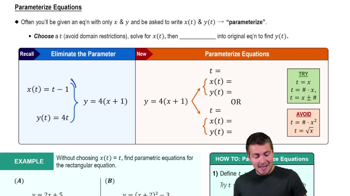
Parameterizing Equations
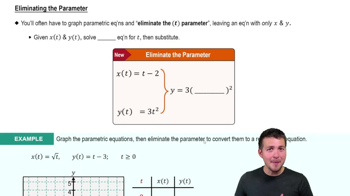
Eliminating the Parameter
Eliminating the parameter involves rewriting the parametric equations to form a single equation relating x and y directly. This is done by solving one equation for the parameter and substituting into the other, which helps in identifying the curve's shape in the xy-plane.
Recommended video:
Guided course
Eliminating the Parameter
Curve Orientation and Description
Curve orientation refers to the direction in which the curve is traced as the parameter increases. Describing the curve involves identifying its shape and key features, while orientation indicates the path's direction, important for understanding motion or flow along the curve.
Recommended video:
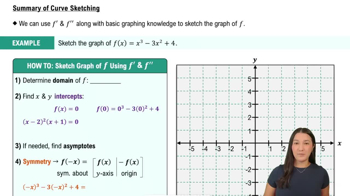
Summary of Curve Sketching
Related Practice
Textbook Question
94
views
Textbook Question
39–50. Equations of ellipses and hyperbolas Find an equation of the following ellipses and hyperbolas, assuming the center is at the origin.
92
views
Textbook Question
What is the polar equation of the horizontal line y = 5?
85
views
Textbook Question
Tangent lines for a hyperbola Find an equation of the line tangent to the hyperbola x²/a² + y²/b² = 1 at the point (x₀, y₀)
138
views
Textbook Question
33–40. Areas of regions Make a sketch of the region and its bounding curves. Find the area of the region.
The region inside the curve r = √(cos θ)
58
views
Textbook Question
Spiral arc length Consider the spiral r=4θ, for θ≥0.
a. Use a trigonometric substitution to find the length of the spiral, for 0≤θ≤√8.
51
views