
Write parametric equations for the rectangular equation below.
Table of contents
- 0. Functions7h 54m
- Introduction to Functions16m
- Piecewise Functions10m
- Properties of Functions9m
- Common Functions1h 8m
- Transformations5m
- Combining Functions27m
- Exponent rules32m
- Exponential Functions28m
- Logarithmic Functions24m
- Properties of Logarithms36m
- Exponential & Logarithmic Equations35m
- Introduction to Trigonometric Functions38m
- Graphs of Trigonometric Functions44m
- Trigonometric Identities47m
- Inverse Trigonometric Functions48m
- 1. Limits and Continuity2h 2m
- 2. Intro to Derivatives1h 33m
- 3. Techniques of Differentiation3h 18m
- 4. Applications of Derivatives2h 38m
- 5. Graphical Applications of Derivatives6h 2m
- 6. Derivatives of Inverse, Exponential, & Logarithmic Functions2h 37m
- 7. Antiderivatives & Indefinite Integrals1h 26m
- 8. Definite Integrals4h 44m
- 9. Graphical Applications of Integrals2h 27m
- 10. Physics Applications of Integrals 3h 16m
- 11. Integrals of Inverse, Exponential, & Logarithmic Functions2h 34m
- 12. Techniques of Integration7h 41m
- 13. Intro to Differential Equations2h 55m
- 14. Sequences & Series5h 36m
- 15. Power Series2h 19m
- 16. Parametric Equations & Polar Coordinates7h 58m
16. Parametric Equations & Polar Coordinates
Parametric Equations
Problem 12.1.17
Textbook Question
15–30. Working with parametric equations Consider the following parametric equations.
a. Eliminate the parameter to obtain an equation in x and y.
b. Describe the curve and indicate the positive orientation.
x = √t + 4, y = 3√t; 0 ≤ t ≤ 16
Verified step by step guidance1
Identify the given parametric equations: \(x = \sqrt{t} + 4\) and \(y = 3\sqrt{t}\) with the parameter range \$0 \leq t \leq 16$.
Express \(\sqrt{t}\) from one of the equations to eliminate the parameter. For example, from \(y = 3\sqrt{t}\), solve for \(\sqrt{t}\): \(\sqrt{t} = \frac{y}{3}\).
Substitute \(\sqrt{t} = \frac{y}{3}\) into the equation for \(x\): \(x = \frac{y}{3} + 4\).
Rearrange the equation to express \(y\) in terms of \(x\): multiply both sides by 3 and isolate \(y\) to get \(y = 3(x - 4)\), which is the Cartesian equation of the curve.
To describe the curve, recognize that it is a straight line with slope 3 and y-intercept at \(y = -12\). The parameter \(t\) increases from 0 to 16, so \(\sqrt{t}\) increases from 0 to 4, meaning \(x\) increases from 4 to 8 and \(y\) increases from 0 to 12. This indicates the positive orientation is from the point \((4,0)\) to \((8,12)\) along the line.
Verified video answer for a similar problem:This video solution was recommended by our tutors as helpful for the problem above
Video duration:
3mPlay a video:
Was this helpful?
Key Concepts
Here are the essential concepts you must grasp in order to answer the question correctly.
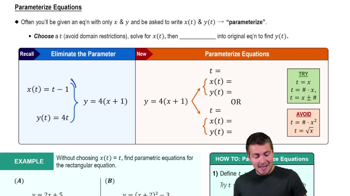
Parametric Equations
Parametric equations express the coordinates of points on a curve as functions of a parameter, often denoted as t. Instead of y as a function of x, both x and y depend on t, allowing the description of more complex curves and motions.
Recommended video:
Guided course
Parameterizing Equations
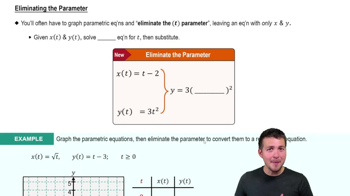
Eliminating the Parameter
Eliminating the parameter involves manipulating the parametric equations to remove t, resulting in a direct relationship between x and y. This process helps to identify the Cartesian equation of the curve, making it easier to analyze its shape.
Recommended video:
Guided course
Eliminating the Parameter
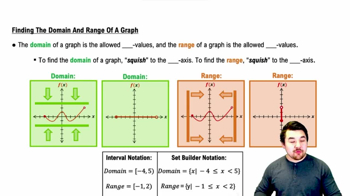
Curve Orientation and Domain
The orientation of a parametric curve is determined by the direction in which the parameter t increases. Understanding the domain of t is essential to describe the portion of the curve traced and to indicate the positive direction along the curve.
Recommended video:
Finding the Domain and Range of a Graph
Watch next
Master Introduction to Parametric Equations with a bite sized video explanation from Patrick
Start learningRelated Videos
Related Practice
Multiple Choice
54
views
