b.Does the series ∑ (from k = 1 to ∞) k/(k + 1) converge? Why or why not?
Table of contents
- 0. Functions7h 54m
- Introduction to Functions16m
- Piecewise Functions10m
- Properties of Functions9m
- Common Functions1h 8m
- Transformations5m
- Combining Functions27m
- Exponent rules32m
- Exponential Functions28m
- Logarithmic Functions24m
- Properties of Logarithms36m
- Exponential & Logarithmic Equations35m
- Introduction to Trigonometric Functions38m
- Graphs of Trigonometric Functions44m
- Trigonometric Identities47m
- Inverse Trigonometric Functions48m
- 1. Limits and Continuity2h 2m
- 2. Intro to Derivatives1h 33m
- 3. Techniques of Differentiation3h 18m
- 4. Applications of Derivatives2h 38m
- 5. Graphical Applications of Derivatives6h 2m
- 6. Derivatives of Inverse, Exponential, & Logarithmic Functions2h 37m
- 7. Antiderivatives & Indefinite Integrals1h 26m
- 8. Definite Integrals4h 44m
- 9. Graphical Applications of Integrals2h 27m
- 10. Physics Applications of Integrals 3h 16m
- 11. Integrals of Inverse, Exponential, & Logarithmic Functions2h 34m
- 12. Techniques of Integration7h 41m
- 13. Intro to Differential Equations2h 55m
- 14. Sequences & Series5h 36m
- 15. Power Series2h 19m
- 16. Parametric Equations & Polar Coordinates7h 58m
14. Sequences & Series
Convergence Tests
Problem 10.8.73
Textbook Question
11–86. Applying convergence tests Determine whether the following series converge. Justify your answers.
∑ (from k = 0 to ∞)k² · 1.001⁻ᵏ
Verified step by step guidance1
Identify the given series: \( \sum_{k=0}^{\infty} k^{2} \cdot 1.001^{-k} \). Notice that the general term is \( a_k = k^{2} \cdot (1.001)^{-k} \).
Rewrite the term to see the exponential part clearly: \( a_k = k^{2} \cdot \left( \frac{1}{1.001} \right)^{k} \). Since \( \frac{1}{1.001} < 1 \), this suggests the terms involve a polynomial factor times an exponential decay.
Consider applying the Ratio Test, which is useful for series involving factorials, exponentials, or powers. The Ratio Test states to compute \( L = \lim_{k \to \infty} \left| \frac{a_{k+1}}{a_k} \right| \).
Calculate \( \frac{a_{k+1}}{a_k} = \frac{(k+1)^2 \cdot (1.001)^{-(k+1)}}{k^2 \cdot (1.001)^{-k}} = \frac{(k+1)^2}{k^2} \cdot \frac{1}{1.001} \).
Evaluate the limit \( L = \lim_{k \to \infty} \frac{(k+1)^2}{k^2} \cdot \frac{1}{1.001} = \left( \lim_{k \to \infty} \frac{(k+1)^2}{k^2} \right) \cdot \frac{1}{1.001} = 1 \cdot \frac{1}{1.001} < 1 \). Since \( L < 1 \), the Ratio Test confirms that the series converges.
Verified video answer for a similar problem:This video solution was recommended by our tutors as helpful for the problem above
Video duration:
2mPlay a video:
Was this helpful?
Key Concepts
Here are the essential concepts you must grasp in order to answer the question correctly.
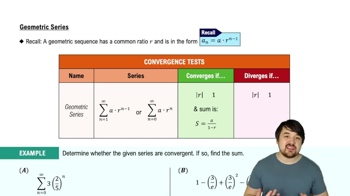
Geometric Series and Its Convergence
A geometric series has terms of the form ar^k, where r is the common ratio. It converges if |r| < 1 and diverges otherwise. Understanding this helps analyze series with exponential terms like 1.001⁻ᵏ, which can be rewritten as (1/1.001)^k, a geometric term with ratio less than 1.
Recommended video:
Geometric Series
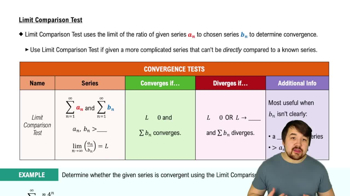
Comparison and Limit Comparison Tests
These tests compare a given series to a known benchmark series to determine convergence. The limit comparison test is useful when terms involve polynomials and exponentials, helping to confirm if the series behaves like a convergent geometric series despite polynomial factors like k².
Recommended video:
Limit Comparison Test
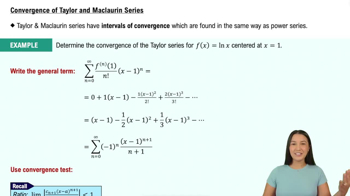
Effect of Polynomial Factors on Series Convergence
Polynomial terms like k² grow slower than exponential decay terms. When combined with a geometric term with ratio less than 1, the exponential decay dominates, often ensuring convergence. Recognizing this balance is key to justifying convergence in series with mixed polynomial and exponential terms.
Recommended video:
Convergence of Taylor & Maclaurin Series
Watch next
Master Divergence Test (nth Term Test) with a bite sized video explanation from Patrick
Start learningRelated Videos
Related Practice
Textbook Question
19
views