
Step 1: Understand the function g(x). It is a piecewise function defined as g(x) = 1 if x \geq 0 and g(x) = -1 if x < 0.
Step 2: Recall the definition of the absolute value function. For any real number y, |y| is y if y \geq 0 and -y if y < 0.
Step 3: Apply the absolute value definition to g(x). Since g(x) is either 1 or -1, consider each case separately.
Step 4: For x \geq 0, g(x) = 1, and |g(x)| = |1| = 1.
Step 5: For x < 0, g(x) = -1, and |g(x)| = |-1| = 1.
Verified video answer for a similar problem:
This video solution was recommended by our tutors as helpful for the problem above
Video duration:
1m
Play a video:
Was this helpful?
Key Concepts
Here are the essential concepts you must grasp in order to answer the question correctly.
Piecewise Functions
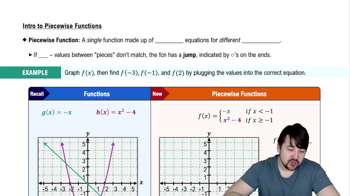
A piecewise function is defined by different expressions based on the input value. In this case, g(x) is defined as 1 for x ≥ 0 and -1 for x < 0. Understanding how to interpret and manipulate piecewise functions is essential for determining their properties and transformations.
The absolute value function, denoted as |x|, represents the distance of x from zero on the number line, always yielding a non-negative result. For the function g(x), the absolute value |g(x)| will convert any negative outputs to positive, which is crucial for writing the formula for |g(x)|.
Function composition involves applying one function to the results of another. In this context, to find |g(x)|, we need to apply the absolute value operation to the outputs of the piecewise function g(x). This concept is fundamental in understanding how to combine different mathematical operations effectively.